4-Stroke Bicycle Engine Kit Safety and Buying Guide
Compare current four-stroke bicycle engine kits by chain or friction drive, package scope, fit, installation, support, and whole-bicycle safety.
Table of Contents
The BBR Tuning 49cc 5G is the first current four-stroke kit we would investigate because its engine, centrifugal gearbox, wide crankset, chain drive, fuel system, and controls are listed as one package. The BBR Tuning 38cc Lock-N-Load is the alternative for a buyer specifically evaluating rear-tire friction drive. Neither is a universal, public-road, or ready-to-install recommendation.
Current options at a glance
| Kit | Drive layout | Useful package distinction | Main reason to pause |
|---|---|---|---|
| BBR Tuning 49cc 5G Pull Start | Centrifugal gearbox, chain, and rear sprocket | Complete engine and transfer-case package with wide crankset | Gearbox, crank, sprocket, and chainline must fit the exact bicycle |
| BBR Tuning 38cc Lock-N-Load | Roller drives the rear tire | Integrated-tank engine and rear-wheel mounting system | Tire contact, wear, traction, rear-wheel loads, and mount clearance need proof |
Both listings displayed an Add to Cart control when checked July 28, 2026. We removed the former transmission-only and engine-assembly links from the shortlist because they are parts, not complete competing conversion systems.
This is a research-based guide. We did not install, ride, fuel-economy test, or performance-test these kits. Merchant speed, power, fit, reliability, fuel-economy, and easy-installation claims are not independent results.
How we chose
We checked current exact product pages for availability, identifiable engines and packages, drive design, listed kit contents, assembly implications, and support. We separated complete systems from replacement assemblies and transmission-only listings.
No kit supplied a universal evidence chain covering host-frame approval, braking and wheel compatibility, legal classification, emissions compliance, installation quality, and finished-system inspection. BikeBerry says its gasoline products are not EPA or CARB compliant for public-road use and are sold for closed-course competition.
Affiliate disclosure: BikeRideReview may earn a commission if you buy through the BikeBerry links below. Confirm the exact current page, selected variant, host bicycle, documentation, and legal use before purchasing.
BBR Tuning 49cc 5G Pull Start
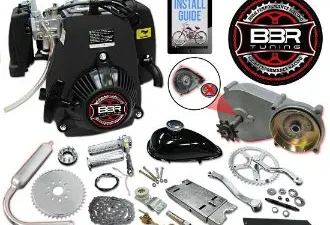
The current page lists a HuaSheng 49cc pull-start engine and BBR 2014 5G centrifugal transfer case with a stated 6:1 reduction ratio. The package also names a 415 chain, 44-tooth sprocket, 1.5-liter tank, fuel line and filter, carburetor, muffler, throttle and kill-switch controls, wide crankset, mounting plate, chain guard, and tools.
That is the clearest complete chain-drive package in the current shortlist. It also creates the most interfaces to verify: engine width, gearbox alignment, crank clearance, rear-sprocket attachment, chainline, exhaust heat, tank mounting, and controls.
Inspect the current BBR Tuning 49cc 5G listing
Our BBR Tuning 49cc 5G review examines the package, naming change, merchant-review themes, and fit limits.
BBR Tuning 38cc Lock-N-Load
The current Lock-N-Load page offers 38cc and 49cc engine-size selections. The 38cc configuration uses a rear-wheel friction-drive system rather than a separate rear sprocket and engine chain. BikeBerry lists an integrated fuel tank and an engine-and-mount package under SKU components FH-LOCKNLOAD-ENGINE and FH-LNL-MOUNTING.
Avoiding a rear sprocket does not remove drivetrain risk. Roller pressure, tire construction, wet traction, tread wear, rear-wheel loading, mount rigidity, cable routing, and clearance all require documentation.
Inspect the current BBR Tuning Lock-N-Load listing
Choose friction drive only when the exact tire, wheel, mount, surface, and maintenance requirements are better documented for your use than a chain-drive system.
Chain drive versus friction drive
| Question | 49cc 5G chain drive | 38cc Lock-N-Load friction drive |
|---|---|---|
| Power path | Gearbox to chain and rear sprocket | Roller contacts rear tire |
| Main alignment concern | Gearbox, sprocket, chainline, and tension | Roller position, pressure, and mount rigidity |
| Rear-wheel concern | Sprocket attachment, axle, spokes or wheel structure | Tire wear, traction, heat, and wheel loading |
| Pedal concern | Included wide crankset still needs clearance | Mount and controls must avoid pedaling and wheel travel |
| Best reason to choose | Documented need for a positive chain drive | Documented need to avoid a rear sprocket |
The correct choice is the one supported by the complete host-bicycle documentation. Drive style alone cannot establish safety or legality.
Fit and safety checklist
Before buying, obtain written documentation for:
- exact engine, transmission or friction-drive mount, and product revision;
- legal classification and permitted operating location;
- host-frame material, dimensions, condition, load, and approved mounting method;
- engine, intake, exhaust, fuel tank, crank, and pedal clearance;
- sprocket, chainline, rear-wheel, axle, or tire-contact compatibility;
- front and rear brake requirements for the complete machine;
- fuel shutoff, line, heat protection, and leak inspection;
- throttle return, kill control, cable routing, and guarding;
- fastener grades, torque values, service parts, and inspection intervals.
Use the motorized bicycle guide for the full system and the engine-ready frame guide before treating open space as approval.
Use the kit-specific measurement and stop-condition checklist before choosing a host bicycle.
What merchant reviews add
The 49cc 5G page displayed 70 merchant-hosted reviews and the Lock-N-Load page displayed 41 when checked. Positive comments can help identify expected use patterns, while critical comments highlight instruction, mount, parts-condition, modification, and fit questions to investigate.
Merchant-hosted ratings do not establish controlled reliability or compatibility. Buyers use different frames, installers, loads, terrain, maintenance, and expectations, so we do not convert those ratings into our own score.
Legal and safety limits come first
Do not treat engine size, pedals, or a seller’s claimed speed as permission to ride on public roads, bike lanes, or trails. NHTSA has historically classified gasoline-powered motorized bicycles made for public-road use as motor-driven cycles subject to motor-vehicle safety rules (NHTSA interpretation). State and local rules can add registration, licensing, equipment, insurance, helmet, and operation requirements.
Stop operation for a fuel leak, abnormal vibration, chain or tire-drive interference, uncontrolled throttle response, brake weakness, overheating, loose mounts, wheel play, structural damage, or steering problems.
Four-stroke versus two-stroke
A four-stroke engine and a conventional two-stroke package create different fuel, drive, size, assembly, and maintenance questions. Neither category is universally safer or easier. Compare exact systems rather than engine-cycle stereotypes.
Our two-stroke bicycle engine kit shortlist covers three current alternatives. The engine-type comparison separates premix, starting, package, drive, and service decisions. A factory-built compliant e-bike is usually the clearer option for ordinary pedal assistance because its frame, motor, controls, wheels, and brakes are designed as a matched system.
Frequently asked questions
Is a four-stroke bicycle engine kit easier to maintain?
Not universally. It changes fuel and engine-service requirements but can add a separate gearbox, wider engine package, crank-clearance work, and drive-specific maintenance.
Does a friction-drive kit fit more bicycles?
A seller may advertise broad compatibility, but the exact tire, wheel, mount, frame, brakes, clearances, and loads still need proof. Friction drive is not universal fit.
Can either kit be used on public roads?
Do not assume so. BikeBerry limits its gasoline products to closed-course competition, and the responsible federal, state, and local authorities determine vehicle and operating requirements.
Final recommendation
Investigate the BBR 49cc 5G first when a four-stroke chain-drive conversion has a documented closed-course purpose. Consider the Lock-N-Load only when its friction-drive interface is better supported for the exact host. In either case, use the motorized bicycle hub to verify the law, frame, brakes, wheels, tires, drive, fuel, controls, and inspection plan before purchase.