Mountain Bike vs Dirt Bike-Things You Don't Know
A mountain bike is pedal-powered trail equipment; a dirt bike is a motor vehicle. Compare access, safety gear, maintenance, noise, and running costs.
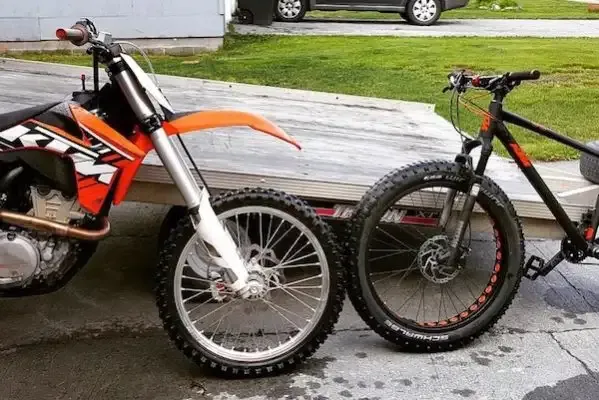
A mountain bike is a human-powered bicycle for bicycle-legal trails. A dirt bike is a motorized motorcycle intended for off-road riding. The difference affects licensing, protective gear, trail access, maintenance, transport, noise, and where you may legally ride.
This is a research-based comparison, not a side-by-side ride test.
Quick comparison
| Question | Mountain bike | Dirt bike |
|---|---|---|
| Power | Pedals, or regulated pedal assist on an e-MTB | Internal-combustion or electric motor |
| Typical access | Bicycle-designated roads and trails | OHV areas and motorized routes |
| Safety gear | Bicycle helmet and trail-appropriate protection | Motorcycle helmet, boots, gloves, eye and body protection |
| Maintenance | Tires, brakes, chain, suspension, bearings | All bicycle-like controls plus motor, fluids, air filter, drivetrain, and fuel or high-voltage system |
| Transport | Many vehicle racks or inside a vehicle | Usually a rated trailer, truck, or motorcycle carrier |
| Noise | Low | Varies; combustion models are much louder |
Which is easier to start with?
A mountain bike has the lower practical barrier for most people. It is easier to transport, can be ridden on more nonmotorized bicycle routes, and does not require learning throttle and motorcycle controls.
That does not make mountain biking risk-free. Fit, brakes, tires, trail difficulty, and protective equipment still matter. Start with the mountain bike buying checklist and a properly fitted bicycle helmet.
A dirt bike requires motorcycle-specific instruction and protective equipment. For public-road use, motorcycle licensing and equipment rules may apply. NHTSA advises riders to be properly licensed and to use a DOT-compliant motorcycle helmet; state requirements vary (NHTSA motorcycle safety).
Where can each one be ridden?
Trail signs and the land manager’s current rules decide access. A route open to mountain bikes is not automatically open to dirt bikes, and an OHV route may be unsuitable or closed to bicycles.
Check the managing agency before leaving home. The Bureau of Land Management maintains separate information for mountain-bike opportunities, while individual field offices publish motorized-route maps and seasonal closures.
E-bikes need a separate check. Their access can differ from both conventional mountain bikes and dirt bikes. Our guide to U.S. mountain-bike destinations explains how to verify current rules.
How do the costs differ?
Purchase price alone is misleading. A mountain bike budget should include a helmet, pump, repairs, wear parts, and suspension service where applicable. A dirt bike adds motorcycle protective equipment, transport, fuel or charging, motor service, registration where required, and potentially OHV permits.
Used dirt bikes can hide expensive engine or suspension work. Used mountain bikes can hide fork, wheel, brake, and frame damage. In either case, a pre-purchase inspection by a qualified mechanic is worth including in the budget.
Fitness and physical demands
A conventional mountain bike makes pedaling the primary source of propulsion. It therefore provides a direct aerobic and muscular workload, with intensity set by terrain, gearing, and pace. A dirt bike still demands balance, grip strength, coordination, and body movement, but the motor supplies propulsion.
Choose based on the activity you want, not an assumption that one is effortless. For pedal-bike preparation, see the new mountain bike setup guide and what to wear for winter mountain biking.
Which should you choose?
Choose a mountain bike if you want pedal-powered exercise, quieter operation, simpler transport, and access to bicycle-legal trails. Choose a dirt bike if you specifically want motorized off-road riding and can support the training, equipment, transport, maintenance, and legal requirements.
Do not convert a bicycle into a dirt-bike substitute without checking classification and structural safety. Adding a gasoline engine can move the machine outside bicycle rules and place loads on a frame, fork, wheels, and brakes that were not approved by their manufacturers.