BMX vs. Dirt Jumper: Which Bike Fits Your Riding?
Choose a freestyle BMX for compact park and street handling, or a dirt jumper for larger wheels, front suspension, and dirt-jump lines.

Table of Contents
- BMX vs. dirt jumper at a glance
- How current bikes illustrate the difference
- Why BMX bikes feel more compact
- Why dirt jumpers use larger wheels and suspension
- Which is better for pump tracks and skateparks?
- Which is better for commuting or trails?
- Can you add BMX pegs to a dirt jumper?
- Safety and buying checks
- How we compared
- Bottom line
Choose a freestyle BMX bike for compact handling, street and skatepark tricks, grinds, and established BMX features. Choose a dirt jumper for shaped jump lines and pump tracks when you want a larger platform, a suspension fork, and a disc brake.
Both categories include exceptions. Compare the exact bike’s intended use and component rating instead of assuming that every BMX or dirt jumper can take the same landing.
BMX vs. dirt jumper at a glance
| Difference | Freestyle BMX | Dirt jumper |
|---|---|---|
| Common adult wheel format | 20 inches | 26 inches |
| Fork | Usually rigid | Usually short-travel suspension |
| Drivetrain | Single speed | Usually single speed |
| Brake setup | Often rear U-brake; model varies | Commonly rear disc brake |
| Handling emphasis | Compact rotation and street/park control | Stability and speed on shaped dirt lines |
| Peg compatibility | Common on compatible freestyle models | Not a defining feature |
| Best match | Street, park, BMX-specific features | Dirt jumps, pump tracks, jump parks |
How current bikes illustrate the difference
The current GT Pro Performer 20 is a useful freestyle BMX example: it has 20-inch wheels, a rigid chromoly fork, a single 28-tooth chainring with a 9-tooth driver, and U-brakes. Those specifications describe that exact model—not every BMX bike.
The current Cannondale Dave shows the typical dirt-jump pattern: 26-inch wheels, a Manitou 100 mm suspension fork, a single-speed drivetrain, integrated chain tensioners, and a rear mechanical disc brake. Cannondale lists jump lines and pump tracks among its intended uses.
These two examples clarify the category difference while avoiding a false universal rule. Junior BMX bikes use smaller wheels, race BMX geometry differs from freestyle, and some dirt-jump platforms support other wheel or drivetrain configurations.
Why BMX bikes feel more compact
A 20-inch freestyle BMX places the wheels, rider, and contact points in a compact package. That helps with rotations, manuals, hops, and repositioning on street or park features. A rigid fork keeps the response direct and removes suspension movement from takeoffs.
The same design is less comfortable for long seated rides and less forgiving on rough ground. Freestyle saddles sit low because the rider normally stands during tricks. One gear is durable and simple, but it is not efficient for sustained climbing.
Use the BMX size guide to compare top-tube length and fit; wheel diameter alone does not determine fit.
Why dirt jumpers use larger wheels and suspension
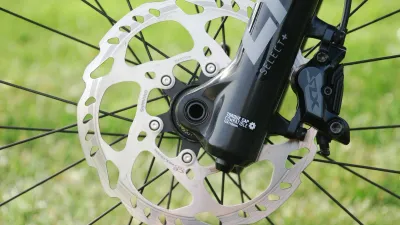
Many adult dirt jumpers use 26-inch wheels and a short-travel fork set up for jump-line control. The larger chassis offers a different balance of speed, stability, and rollover than a 20-inch BMX. A rear disc brake provides predictable speed control away from rim-brake surfaces.
Cannondale’s mountain-bike category guide describes dirt jumpers as specialized hardtails, commonly with 100 mm forks, 26-inch wheels, and simple single-speed drivetrains. This does not make them ordinary trail bikes: low gearing, long-distance fit, and trail-focused suspension are usually absent.
Which is better for pump tracks and skateparks?
Either can work where the venue permits it. A BMX favors tight transitions and BMX-style park or street tricks. A dirt jumper favors riders who want its larger-wheel feel and suspension on pump tracks, jump parks, and flowing lines.
Check the venue’s rules and inspect every feature before riding. Do not assume a landing is safe because another rider cleared it. Progression, protective gear, and qualified coaching matter more than the category name.
Which is better for commuting or trails?
Neither is an ideal all-purpose commuter. Both typically have one gear, low saddles, and limited cargo provisions. A conventional commuter, hybrid, or trail bike is a better match for hills and distance.
A dirt jumper is also not a substitute for a trail mountain bike. It may lack a front brake, wide gearing, trail tires, and suspension tuned for repeated rough descents. The BMX-versus-mountain-bike guide covers that broader choice.
Can you add BMX pegs to a dirt jumper?
Only if the exact frame, fork, hub, axle, and peg makers approve the installation. Pegs change axle engagement and loads. Many dirt-jump thru-axles and hub systems are not designed around BMX pegs.
Read what bike pegs are used for before buying them. Never remove required washers or compromise axle-thread engagement to make a peg fit.
Safety and buying checks
Confirm the bike’s stated ASTM or manufacturer use category, rider and system limits, wheel-retention method, brake equipment, and component service requirements. Inspect the frame, fork, wheels, bars, stem, cranks, pedals, chain, and brakes after a hard landing.
Stop riding after an unexplained crack, bend, looseness, steering shift, wheel movement, brake failure, or harsh bottom-out. Have a qualified mechanic inspect any suspected impact damage.
How we compared
This is a research-based category comparison, not a new side-by-side ride, jump, impact, or durability test. We checked current GT and Cannondale model documentation on August 1, 2026 and used each exact bike only to illustrate a category pattern. We did not generalize a component, geometry, intended-use, or safety claim from those two examples to every BMX bike or dirt jumper.
Bottom line
The BMX is the more compact street-and-park tool; the dirt jumper is the larger, suspension-fork platform for shaped dirt lines and pump tracks. Buy for the features you actually ride, then verify the exact model’s use rating and fit.