

Motorized Bicycle Guide: Engines, Frames, and Safety
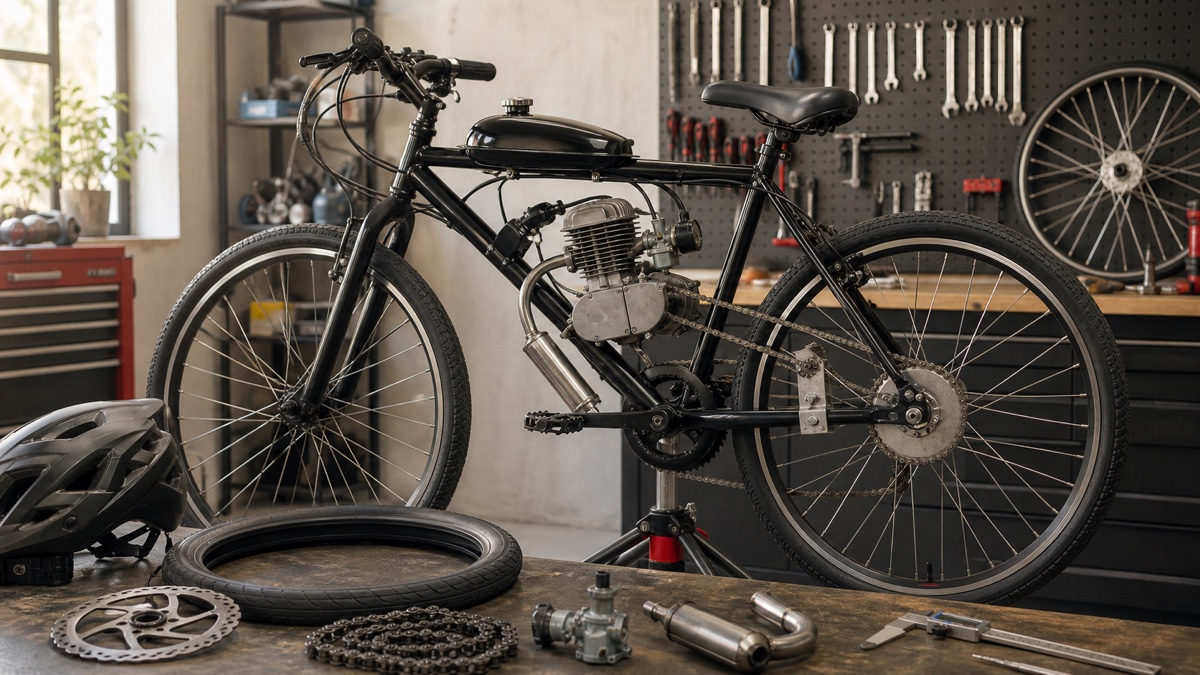
A motorized bicycle should be treated as a complete vehicle system, not a bicycle plus an engine. The engine changes legal classification, speed, mass, vibration, heat, braking demand, and loads on parts that may never have been approved for powered use. Start with the law and host bicycle, then evaluate the engine, drive, wheels, tires, brakes, controls, fuel system, support, and maintenance plan together.
This guide organizes BikeRideReview’s research-based motorized-bicycle coverage. We do not present a gasoline conversion as universally safe, compatible, or legal.
Start with legality and intended use
Do not buy a kit until you know where the completed machine may legally operate. A gasoline-powered bicycle intended for public roads may be classified as a motor-driven cycle, with registration, licensing, equipment, insurance, and helmet requirements. NHTSA has distinguished gasoline motorized bicycles from qualifying electric pedal-assist bicycles in past interpretations (NHTSA interpretation).
Federal guidance does not replace state and local rules. Trail access is separately controlled by the land manager. BikeBerry also states that its gasoline products are not EPA or CARB compliant for on-road or off-road public use and are sold for closed-course competition.
Recent community discussions show why engine size alone is a poor legal shortcut. Riders often assume that a 49cc label or operable pedals decide the vehicle class, while other participants point to state-specific definitions and speed limits (50CC engine recommendations?). Treat those discussions as questions to take to the responsible agency, not legal advice.
If the goal is ordinary transportation or trail access, a factory-built compliant e-bike is usually the clearer research path. Our electric bike conversion kit guide explains the differences for riders still comparing systems.
Choose an engine category by system requirements
Search data separates the broad engine-kit category, two-stroke roundups, four-stroke roundups, and exact 49cc product research into distinct result sets. That reflects different decisions. Start with the category that matches the intended system, then move to an exact product.
Two-stroke kits
Two-stroke kits commonly package an in-frame engine, carburetor, ignition, exhaust, clutch controls, fuel tank, rear sprocket, and chain. They still vary by cylinder design, nominal displacement, included hardware, assembly burden, and staged performance parts.
Use the best two-stroke bicycle engine kit shortlist to compare current conventional packages. The BBR Tuning Angle Fire review examines the basic 66/80cc model, while our 80cc versus 100cc comparison explains why a larger label is not automatically better.
Four-stroke kits
Four-stroke packages can use a separate reduction gearbox and chain drive or a roller that drives the rear tire. Avoid assuming that four-stroke means easy installation or low maintenance. Gearbox alignment, engine width, wide-crank clearance, drive interfaces, and service support still need documentation.
Our four-stroke bicycle engine kit guide compares the current layouts. The BBR Tuning 49cc 5G review covers the complete chain-drive package and its fit limits.
Chain drive versus friction drive
A chain-drive kit adds a rear sprocket, engine chain, alignment, tension, wheel-interface, and guarding decisions. A friction-drive kit avoids the rear sprocket but transfers power through a roller at the tire, adding tire-contact, traction, wear, heat, and roller-pressure questions.
Neither design is universally better. Compare the exact drive reduction, wheel and tire interfaces, mount, service parts, and intended surface. Community threads about four-stroke builds repeatedly return to gearbox or belt reduction, chainline, wide-crank position, and mount alignment. Those reports are useful for identifying pre-purchase questions, but they do not establish that every example of a drive design will behave the same.
The host bicycle is not a generic donor
A large open frame triangle does not prove that a bicycle can carry an engine. The exact frame model, material, tube profiles, joints, condition, load limits, and approved mounting method matter. Many ordinary bicycle warranties exclude internal-combustion engines and unapproved modifications.
Do not drill, weld, grind, or crush-clamp a frame without a written manufacturer procedure. Forum discussions include builders considering cut-and-weld changes merely to make an engine fit (I need help :/). That is a warning to choose another host or a purpose-built system, not a modification recipe.
Use the bicycle frame for an engine guide before interpreting a merchant’s fit range as structural approval.
Make a full-size mock-up before ordering
One useful idea in current merchant fit guidance is a paper or cardboard engine stencil. Ask the seller for the exact engine, carburetor, air-filter, exhaust, mount, and crank dimensions for the chosen product revision. Build a full-size profile, position it in the frame, and check:
- frame-tube contact at every mount;
- vertical space above the cylinder or engine cover;
- carburetor and air-filter access;
- exhaust path and heat clearance;
- crank and pedal rotation;
- fuel-tank position and line routing;
- gearbox, chain, sprocket, or friction-drive alignment;
- cable movement through the full steering range.
A two-dimensional stencil cannot prove structural suitability or side-to-side clearance. Follow it with measurements of engine width, crank position, chainline, wheel interfaces, and every moving part.
Brakes, wheels, and tires are primary safety systems
Added mass and powered speed can raise the demands on both brakes, wheels, axles, tires, fork, headset, and steering. An engine-kit listing rarely establishes that the rest of the bicycle is suitable.
- The motorized-bicycle wheel guide covers axle, brake, drive, and documentation questions.
- The motorized-bicycle tire guide explains why size alone does not establish load, speed, heat, or rim compatibility.
- The 80cc speed guide explains why merchant top-speed ranges are not reliable buying targets.
Recent builder discussions pair engine and wheel decisions because hub, sprocket, brake, and frame interfaces cannot be chosen independently (Help choosing parts as a beginner). That is a sound research sequence even though individual component recommendations in a forum still need manufacturer verification.
Stop riding for weak or inconsistent braking, rim or hub damage, spoke problems, wheel play, tire cuts or bulges, steering looseness, or structural damage.
Fuel, carburetor, and exhaust need their own plan
A safe fuel system needs a secured tank, compatible line and filter, shutoff control, protected routing, leak inspection, and clearance from hot or moving parts. The throttle must return predictably, and the engine kill control must work before operation.
Use the motorized-bicycle carburetor guide for mixture, fit, cable, and air-filter questions. The motorized-bicycle exhaust guide covers heat, clearance, mounting, sound, and tuning limits.
Never operate a machine with a fuel leak, sticking throttle, damaged line, loose exhaust, or overheating.
Chainline and tension are not setup details
The engine drive chain, rear sprocket, wheel, axle, and tensioner form one safety-critical system. Misalignment or a poorly secured tensioner can put the chain near the tire, spokes, frame, rider, or other moving parts.
The motorized-bicycle chain-tensioner guide explains alignment and inspection questions. A component sold as an upgrade does not fix an unsuitable chainline or weak mounting surface.
Long-running forum threads document cases where motor position, chain length, and lateral alignment could not all be satisfied by the supplied bracket (SpookyTooth/BikeBerry Impossible Alignment). The practical lesson is to verify the whole geometry before ordering, not to copy an unverified modification.
Research performance parts by the added dependency
Staged engine packages can change the cylinder head, intake, carburetor, ignition, spark plug, and exhaust. Every change can add heat, clearance, mixture, sound, maintenance, and parts-identity questions.
Our BBR Stage 1 versus Stage 2 versus Stage 3 versus Stage 4 comparison separates the current package contents. Choose a staged kit only when a documented use case justifies each added system.
Review warranty, returns, and support before adding fuel
Kit ownership can require diagnosis and parts replacement. Read the current seller policies before purchase and save a dated copy with the order.
BikeBerry’s current return policy limits returns to products in new condition that have not been installed, fueled, started, or ridden. It also describes buyer-paid return shipping, an RMA requirement, and a possible restocking fee (BikeBerry return policy). Its warranty policy describes part-level diagnosis, photos, possible return of defective parts, excluded wear items, and buyer responsibility for labor and shipping (BikeBerry warranty policy).
Before ordering, ask:
- Which warranty term applies to the exact brand and SKU?
- What evidence and troubleshooting are required for a claim?
- Who pays shipping for a defective part or complete return?
- Does fueling or starting the engine end ordinary return eligibility?
- Are labor, tools, consumables, and damage to the host bicycle excluded?
- Which exact replacement parts are currently stocked?
- Is the installation manual available before purchase?
A recent BikeBerry customer discussion centered on the gap between expecting a complete return and being asked to diagnose a non-running engine (Impossible returns). That single account cannot establish general service quality, but it shows why buyers should understand the written process before assembly.
A defensible buying sequence
- Confirm legal classification and the exact operating location.
- Define the intended closed-course use, load, terrain, and maintenance capacity.
- Obtain written host-frame approval for the exact system.
- Make a full-size mock-up and measure every engine, drive, crank, intake, exhaust, fuel, wheel, and chain interface.
- Verify both brakes, wheels, tires, fork, headset, and controls.
- Identify exact product revisions, replacement parts, instructions, torque values, warranty, returns, and support.
- Use a qualified installer and document the completed inspection.
- Begin with a controlled low-speed check away from traffic, then reinspect.
Do not advance to the next step when a legal, structural, fit, documentation, or support dependency is unresolved.
Essential pre-ride inspection
Before every operation, check:
- fuel tank, cap, line, filter, shutoff, and visible leaks;
- throttle return, clutch control, and engine kill switch;
- engine, gearbox, exhaust, tank, and accessory mounts;
- chain condition, alignment, tension, guard, and clearances;
- front and rear brake operation;
- tire pressure and damage;
- wheel security, bearing play, spokes or structural wheel condition;
- frame, fork, headset, handlebar, crank, and pedals.
Stop for any change in vibration, sound, heat, steering, braking, chain behavior, or fuel smell. Inspection intervals should come from the exact component documentation, not a generic article.
Frequently asked questions
Is a motorized bicycle legally the same as an e-bike?
No universal equivalence exists. Federal low-speed electric-bicycle definitions address qualifying electric systems, not gasoline conversions. Vehicle classification and operating rules depend on the exact system and jurisdiction.
What bicycle is best for an engine kit?
Only a bicycle whose manufacturer approves the exact conversion and complete loads is a defensible host. Frame shape, steel construction, or wheel size alone does not establish suitability.
Is a two-stroke or four-stroke kit better?
Neither category wins universally. Two-stroke and four-stroke packages create different fuel, drive, size, assembly, and maintenance requirements. Choose from documented system compatibility, not a generic performance claim.
How fast will a motorized bicycle go?
There is no responsible universal figure. Gearing, wheel size, mass, grade, wind, engine state, installation, and legal limits all matter. Braking and component ratings take priority over a seller’s range.
Can a beginner install a bicycle engine kit?
A basic kit can still require engine assembly, frame and drive measurement, fuel-system work, torque procedures, troubleshooting, and whole-bicycle inspection. A first-time buyer should arrange qualified mechanical help before purchase rather than relying on an “easy installation” claim.
Where to go next
Begin with the two-stroke kit shortlist or four-stroke kit guide, then evaluate the host frame, wheels, tires, and chain system. A kit purchase is the last step in that research sequence, not the first.
Routing engine power through bicycle gearing adds another layer of compatibility and maintenance. Read our research-based verdict on whether a motorized bicycle jackshaft kit is worth it.