Bicycle Frame for an Engine: Safety and Compatibility Guide
Do not choose a bicycle frame for a gasoline engine by tube size alone. Verify legal classification, manufacturer approval, mounts, brakes, wheels, and loads.
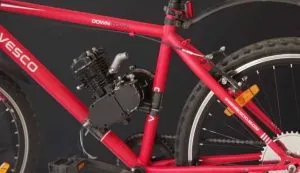
Table of Contents
- Start with four independent approvals
- No bicycle-frame type is universally suitable
- Measure the engine and service envelope
- Treat mounts as a load path
- Brakes, fork, wheels, and tires remain one system
- Fuel, heat, exhaust, and controls need their own review
- Use a written compatibility worksheet
- Screen the donor before installation
- Plan the first test and recurring inspection
- Bottom line
The right bicycle frame for an engine is one whose maker approves the exact engine, mounts, loads, and finished use in writing. Tube material, wheel diameter, and open space cannot establish that approval. If the frame or system maker cannot document the complete match, do not use that frame as an engine donor.
This is a research-based compatibility guide, not a frame endorsement or installation test. Current search results still favor broad retailer and forum claims about steel cruisers, rigid mountain bikes, and tank frames. Those claims do not replace model-specific engineering limits, installation instructions, legal classification, or a qualified inspection.
Start with four independent approvals
A safe proposal needs four separate answers. One answer cannot stand in for the others.
| Decision | Evidence to obtain | Reject when |
|---|---|---|
| Legal use | Written rules for the finished vehicle and intended road or trail | The seller treats a bicycle rule as permission for a gasoline vehicle |
| Frame | Frame-maker approval for exact engine, mount, load, and use | Approval is generic, verbal, or based only on tube dimensions |
| Conversion system | Current instructions, parts list, limits, and inspection schedule | Instructions are missing or the kit revision cannot be identified |
| Interfaces | Documented fit for brakes, fork, wheels, tires, controls, fuel, exhaust, and drive | Any load, clearance, fastening, or service question is unresolved |
NHTSA’s interpretation for the gasoline-powered Crow beach cruiser found that a vehicle capable of propulsion solely by its engine was a motor vehicle and, on the supplied facts, a motor-driven cycle (NHTSA interpretation 07-007541as). State and local rules can add registration, licensing, equipment, insurance, helmet, noise, and access requirements. Check the responsible agencies for the completed vehicle, not just the donor bicycle.
No bicycle-frame type is universally suitable
Steel is not automatic approval. Aluminum is not an automatic diagnosis. Carbon is not a platform for improvised clamps. Material is only one property of a particular frame design.
Tube shape, wall thickness, heat treatment, joints, butting, corrosion, previous impacts, fatigue history, attachments, and intended load all matter. A used frame adds uncertainty because its service and crash history may be incomplete. A fresh coat of paint cannot resolve that uncertainty.
The same rule applies to a purpose-built-looking tank frame. Integrated fuel space or engine-room geometry may help packaging, but it does not prove compatibility with every engine, fork, wheel, brake, rider load, or jurisdiction. The seller or manufacturer must identify the exact interfaces and limits for the revision being purchased.
Measure the engine and service envelope
An engine that fits while stationary may still interfere when installed, adjusted, or serviced. Record the exact engine revision and measure the full operating envelope described by its instructions.
Check all of these areas:
- engine head, spark plug, carburetor, filter, intake, fuel valve, and exhaust clearance;
- pedal and crank clearance through a complete rotation;
- clutch arm, throttle, kill-switch, and cable travel without tight bends;
- primary chain, rear sprocket, tensioner, tire, chainstay, and spoke clearance;
- fuel-line routing away from heat, sharp edges, and moving parts;
- access for specified tools, fastener checks, and routine maintenance;
- rider-leg clearance and safe access to every control.
Do not solve a clearance failure by drilling, grinding, welding, spreading, denting, or crush-clamping the frame unless the frame maker publishes a procedure for that exact model and conversion. An adapter changes the interface; it does not grant structural approval.
Treat mounts as a load path
Each mount carries vibration and force into the frame. Its shape, contact area, fasteners, torque, locking method, and inspection interval need documented values from the applicable maker. A clamp that merely closes around a tube can still concentrate load or move in service.
Reject mismatched saddles, partly engaged fasteners, improvised shims, and hardware of unknown grade. Stop if tightening visibly deforms a tube or if the mount only sits square after forcing the engine sideways. The installed engine must not become the tool used to bend the chassis into alignment.
The natural checkpoint is simple: open space is packaging evidence, not structural evidence.
Brakes, fork, wheels, and tires remain one system
The CPSC bicycle rules include braking and structural tests for ordinary consumer bicycles (CPSC bicycle FAQ). Those requirements do not certify a gasoline conversion or establish suitability for added mass, vibration, or speed.
Obtain written limits for the exact fork, headset, brakes, rims, spokes, hubs, axles, tires, and frame. Match tire size to the rim and confirm frame, fork, brake, and drive clearance. Verify axle retention and brake compatibility at both wheels. Do not infer a safe converted-vehicle speed from a merchant’s engine claim.
Stop work for a crack, dent, bent tube, damaged weld, corrosion loss, loose headset, wheel play, rim damage, weak brake, tire damage, or an axle that will not retain correctly. A qualified bicycle or motorcycle professional familiar with the finished vehicle should assess uncertainty before power is applied.
Fuel, heat, exhaust, and controls need their own review
The fuel tank must have documented mounts and clearance from sharp edges, hot parts, and moving controls. The shutoff and line need an inspectable route. The exhaust must remain securely supported with safe clearance from the rider, tire, cables, fuel system, and frame finish.
The throttle must return as specified, the clutch must operate through its full travel, and the kill switch must be reachable without releasing control of the bicycle. Protect wiring and cables against heat, abrasion, steering movement, and snagging. Never test a leaking fuel system or a control that binds.
Use a written compatibility worksheet
Before buying, record:
- Frame maker, model, size, year, revision, serial information, and condition.
- Engine and kit maker, model, revision, mass, rated output, and included mounts.
- Approved mounting points, fasteners, torque values, locking methods, and recheck interval.
- Maximum rider, cargo, and system loads for the complete configuration.
- Fork, headset, brake, wheel, axle, rim, and tire requirements.
- Both drive paths, sprocket interfaces, chainline, guards, and clearance.
- Fuel, heat, exhaust, throttle, clutch, wiring, and kill-switch routing.
- Registration, equipment, insurance, helmet, noise, and route restrictions.
- Current instructions and replacement-part support.
- Installer qualification and post-install inspection plan.
Blank fields are not permission to proceed. Save the source document and date because product pages and instructions can change.
Screen the donor before installation
Clean the frame enough to inspect tubes, welds, joints, dropouts, fork, headset area, bottom bracket, and brake mounts. Look for rippled paint, rust bleed, stress marks, fretting around hardware, dents, bulges, and alignment problems. Check the maker’s recall and service information for the exact model.
Do not use a damaged frame as a low-cost experiment. Do not assume a mechanic can approve an undocumented modification simply by looking at it. Professional inspection can find problems and verify assembly, but it cannot invent a missing manufacturer load case.
Plan the first test and recurring inspection
Complete a static inspection before adding fuel or starting the engine. Verify steering, wheel retention, brakes, chain clearance, guards, fasteners, controls, and leaks. Use the maker’s exact checklist and torque values where supplied.
The first powered test belongs in a controlled area away from traffic and bystanders. Begin at low speed. Stop immediately for movement, rubbing, unusual vibration, noise, heat, fuel odor, control change, chain instability, brake change, or steering change. Reinspect at the interval specified for the conversion and after any impact or component change.
Our motorized bicycle guide maps the complete vehicle. The two-stroke kit guide and four-stroke kit guide cover engine-side evidence, while the motorized tire guide and motorized wheel guide cover two critical interfaces.
Bottom line
Do not select a bicycle frame for an engine by a generic frame type, tube diameter, or retailer fit claim. Proceed only when exact legal, frame, system, and interface evidence agrees for the completed vehicle. If one part of that record is missing, choose a documented purpose-built vehicle instead.