BBR Tuning 49cc 5G Four-Stroke Engine Kit Review
The BBR Tuning 49cc 5G is a complete four-stroke bicycle kit, but frame fit, transmission alignment, braking, installation, and legal-use limits remain.

Table of Contents
- Quick verdict
- What is included
- Four-stroke strengths and tradeoffs
- Chain drive versus friction drive
- Fit and installation checks
- What merchant reviews can and cannot tell us
- Support and return questions to settle first
- Legal and safety limits
- Who should consider it
- Frequently asked questions
- Final recommendation
The BBR Tuning 49cc 5G is a relatively complete four-stroke bicycle conversion kit, but it is not a universal or public-road recommendation. Its pull-start engine, centrifugal gearbox, wide crankset, drive parts, fuel system, and controls give a buyer an identifiable package to inspect. They do not prove that the kit fits a particular bicycle or that the finished machine is legal and safe.
Research disclosure: We did not install or ride this kit. This review uses the current BikeBerry product page, listed SKU and package contents, merchant-hosted review themes, federal guidance, and compatibility research checked July 28, 2026. Speed, fuel-economy, power, easy-installation, and reliability statements on the merchant page are not independent test findings.
Quick verdict
Consider the 49cc 5G only when a four-stroke gasoline conversion serves a documented closed-course need and a qualified installer has approved the host bicycle. The complete package and automatic centrifugal drive reduce some parts-sourcing questions. Engine width, crank clearance, gearbox alignment, chainline, fuel routing, braking, and frame approval remain major unresolved dependencies.
| Decision point | Our assessment |
|---|---|
| Exact current product | BBR Tuning 49cc 5G Pull Start, SKUs FH-TRANSKIT-4S and FH-ENGINE-4S |
| Best fit | Closed-course builder who specifically wants a four-stroke layout |
| Main advantage | Engine, gearbox, drive, controls, fuel system, and wide crankset are listed together |
| Main limitation | Package completeness does not establish host compatibility |
| Evidence level | Merchant documentation; no independent hands-on test |
What is included
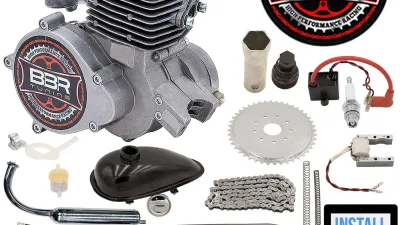
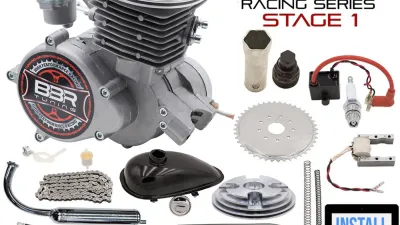
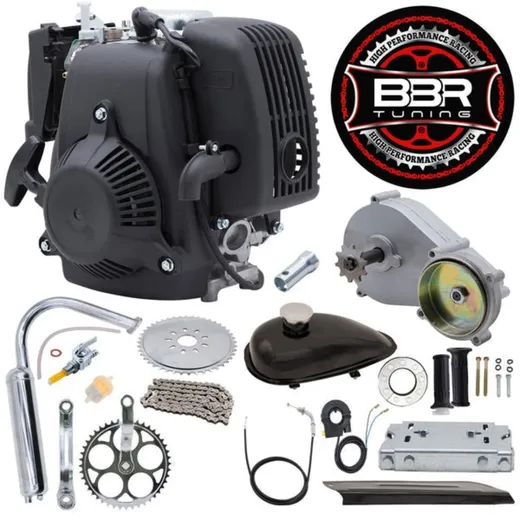
BikeBerry currently lists a HuaSheng 49cc pull-start engine and BBR 2014 5G centrifugal transfer case with a stated 6:1 reduction ratio. The package also names a 415 chain, 44-tooth sprocket, 1.5-liter tank, fuel line and filter, low-profile carburetor, muffler, throttle and kill-switch controls, wide crankset, mounting plate, chain guard, and tools.
Those details matter because a buyer can compare the package against the actual bicycle. They do not remove the need to verify fastener specifications, mounting loads, clutch and gearbox alignment, drive-chain clearance, exhaust heat, throttle return, fuel shutoff, or brake performance.
The visible product naming now uses BBR Tuning even though the URL and some older references use Flying Horse. Record both the current name and the exact SKUs when seeking support or replacement parts.
Four-stroke strengths and tradeoffs
A small four-stroke does not require premixed fuel in the same way as a conventional two-stroke, and the centrifugal transfer case changes how power reaches the drive chain. Those can be useful configuration differences. They are not proof of lower maintenance, better reliability, or easier installation on a specific frame.
The four-stroke package is physically wider than a bare bicycle drivetrain. The included wide crankset signals that pedal clearance is part of the design problem. The transfer case adds another alignment, mounting, lubrication, and service dependency. Measure the entire installed envelope rather than comparing engine displacement alone.
Our four-stroke bicycle engine kit guide compares this chain-drive layout with BBR’s current friction-drive alternative.
Chain drive versus friction drive
The 49cc 5G uses a gearbox, chain, and rear sprocket. That creates explicit sprocket alignment, chain tension, wheel-interface, and guarding decisions. BBR’s current 38cc Lock-N-Load listing instead transfers power through a roller at the rear tire. Friction drive avoids a rear sprocket but adds tire-contact, traction, wear, and roller-pressure questions.
Neither design is universally better. Choose only after documenting the host bicycle and intended closed-course surface. A chain drive with poor alignment is not defensible, and a friction drive with unverified tire compatibility is not a shortcut.
Fit and installation checks
Before ordering the kit, obtain written answers for:
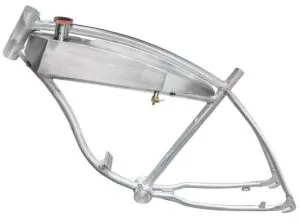
- frame model, material, tube shapes, dimensions, and approved mounting method;
- engine, transfer-case, air-filter, and exhaust clearance;
- wide-crank installation and pedal clearance through a full rotation;
- rear sprocket attachment, wheel and axle loads, and chainline;
- throttle, kill-switch, fuel-line, filter, and tank routing;
- brakes, tires, wheels, fork, and headset for the complete system;
- fastener grades, torque values, break-in, and inspection intervals;
- current parts support for both listed SKUs.
Do not treat a merchant’s broad fit statement as manufacturer approval. The engine-frame compatibility guide explains why tube size and open space are not enough.
What merchant reviews can and cannot tell us
The product page showed a 4.7 rating across 70 merchant-hosted reviews when checked. Reviews commonly praise starting behavior and usable low-speed torque, while critical reports mention unclear instructions, mounting work, modification, and occasional damaged or inconsistent parts.
That pattern helps identify questions to ask before purchase, but it is not a controlled durability study. The buyers used different bicycles, installation methods, loads, terrain, maintenance, and expectations. We do not convert the displayed rating into our own product score.
Recent community questions about 49cc four-stroke builds also focus on gearbox or belt reduction, clutch behavior, mount fasteners, and alignment (Advice for a Noob’s First Project). Those comments do not prove a defect in this exact 5G product. They identify specifications to confirm in writing: the actual reduction ratio, transmission revision, clutch and output parts, fastener grades and thread sizes, and available replacements.
Support and return questions to settle first
BikeBerry’s current return policy defines new condition as not installed, fueled, started, or ridden. It also describes an RMA requirement, buyer-paid return shipping, and a possible restocking fee (BikeBerry return policy). The warranty policy describes part-level diagnosis, photos, excluded wear items, and buyer responsibility for labor and some shipping (BikeBerry warranty policy).
Before assembly, save both policies and ask which term applies to the current BBR-labeled product and its two listed SKUs. Inventory the engine, gearbox, wide crankset, drive, tank, controls, mounts, and hardware before adding oil or fuel.
Legal and safety limits
BikeBerry says its gasoline products are not EPA or CARB compliant for on-road or off-road public use and are sold for closed-course competition. Do not treat the engine’s small displacement, pedals, or a seller’s claimed speed as an exemption.
NHTSA has historically classified gasoline-powered motorized bicycles made for public-road use as motor-driven cycles subject to motor-vehicle safety rules (NHTSA interpretation). State and local registration, licensing, equipment, insurance, helmet, and operation rules can also apply.
Stop operation for fuel leakage, uncontrolled throttle response, brake weakness, wheel play, abnormal vibration, loose mounts, chain interference, overheating, structural damage, or steering problems.
Who should consider it
The 49cc 5G is worth researching for a mechanically experienced builder who has:
- a confirmed legal closed-course use;
- written host-bicycle and system approval;
- exact measurements for the engine, gearbox, wide crankset, and drive;
- access to qualified installation and inspection;
- a current replacement-parts and maintenance plan.
It is not a good choice for public-road commuting, a buyer expecting universal fit, or someone who wants a maintenance-free bicycle. A factory-built compliant vehicle offers a clearer matched-system path.
BBR Tuning 49cc 5G Pull Start Bicycle Engine Kit
A complete 49cc four-stroke chain-drive package to investigate only after the host bicycle, installation, and intended use are approved.
Best for: Mechanically experienced closed-course builders with a documented compatible bicycle
- Engine
- HuaSheng 49cc pull-start
- Drive
- 5G centrifugal chain drive
- Package
- Wide crankset and drive parts included
Watch-out: Package completeness does not establish frame fit, safe braking, legal use, or installation quality.
Affiliate link · Opens BikeBerry in a new tab
Inspect the current BBR Tuning 49cc 5G listing
Frequently asked questions
Is the BBR 49cc 5G the same as the Flying Horse kit?
The current page title uses BBR Tuning, while the URL and older references use Flying Horse. Match the current listed engine and transmission SKUs before assuming an older guide or replacement part applies.
Is a four-stroke kit easier to install than a two-stroke kit?
Not universally. The fuel and engine-cycle differences do not remove frame mounting, crank clearance, gearbox alignment, chainline, controls, exhaust, wheel, tire, and brake work.
Can this kit be used on public roads?
Do not assume so. BikeBerry’s own notice limits its gasoline products to closed-course competition, and the responsible federal, state, and local authorities determine vehicle and operating requirements.
Final recommendation
The BBR Tuning 49cc 5G is a coherent package to investigate when a four-stroke chain-drive conversion is specifically justified. It is not a universal fit or legal-road solution. Start with the motorized bicycle guide, compare the active four-stroke kit layouts, and proceed only after every host, drivetrain, braking, fuel, and legal dependency is documented.