BBR Tuning 66/80cc Angle Fire Engine Kit Review
The BBR Angle Fire is a straightforward two-stroke kit to research, but installation, frame fit, braking, legality, and merchant-only claims limit who should buy it.
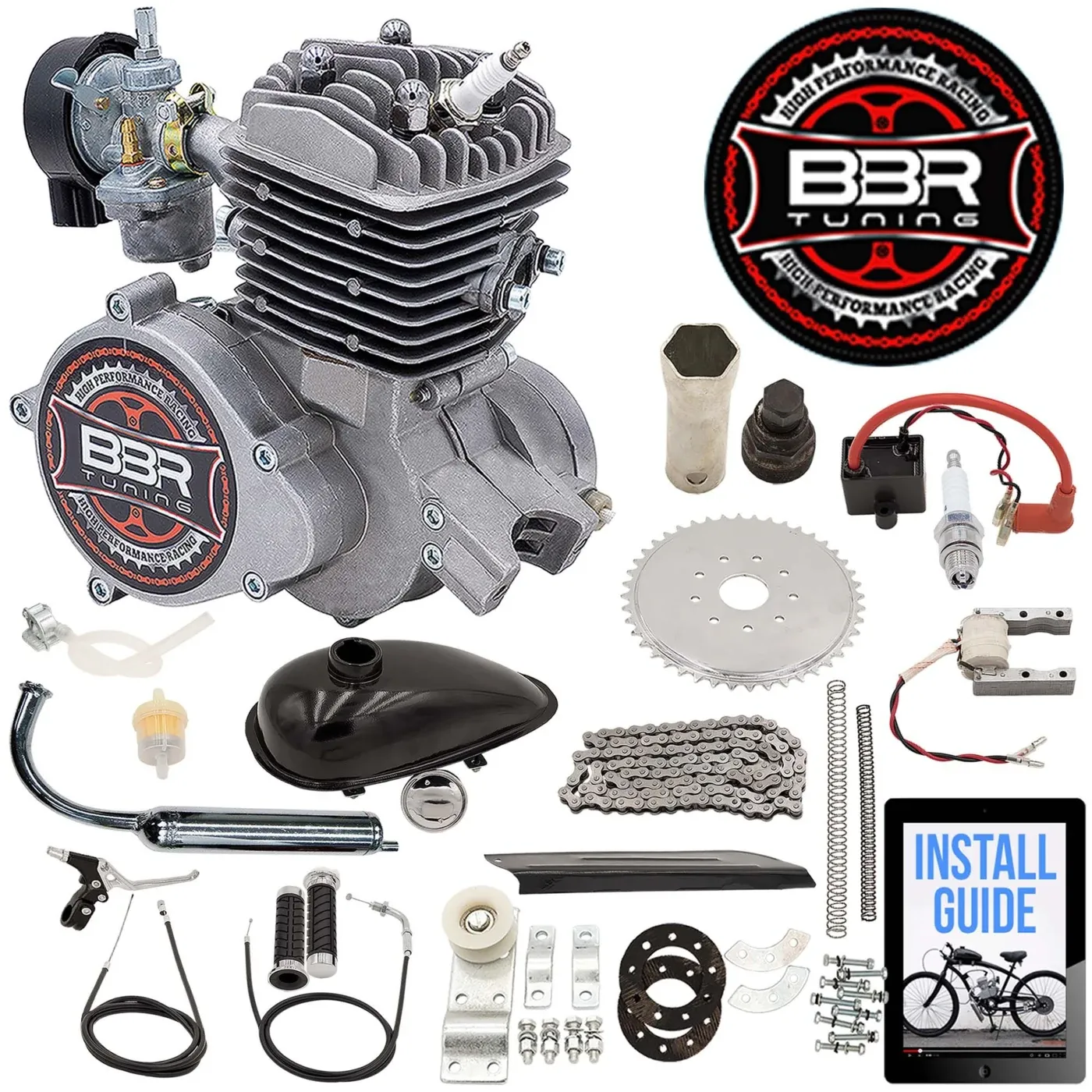
Table of Contents
- Quick verdict
- What the kit includes
- What makes the Angle Fire the sensible BBR starting point
- Fit questions the product page cannot answer
- Installation and maintenance burden
- Support and return questions to settle first
- Legal and road-use limits
- Who should consider it
- Frequently asked questions
- Final recommendation
The BBR Tuning 66/80cc Angle Fire is one of the simpler complete two-stroke kits in BikeBerry’s current lineup, which makes it a more defensible research starting point than a staged or electric-start package. It is not a universal recommendation. The kit still requires top-end assembly, a compatible host bicycle, qualified installation, and legal closed-course use.
Research disclosure: We did not install, ride, or dynamometer-test this kit. This review is based on the current BikeBerry product page, listed package contents, merchant-hosted review themes, federal guidance, and compatibility research checked July 28, 2026. Merchant performance and reliability claims are not independent test results.
Quick verdict
Consider the Angle Fire only if you specifically want a conventional two-stroke package and can document the entire build before ordering. Its strengths are an identifiable current SKU, a detailed parts list, and fewer added tuning systems than BBR’s staged packages. Its weaknesses are significant: top-end assembly is required, broad fit language does not prove bicycle compatibility, and BikeBerry states that its gasoline products are not EPA or CARB compliant for public-road use.
| Decision point | Our assessment |
|---|---|
| Exact current product | BBR Tuning 66/80cc Angle Fire, SKU STK-BEK80-S |
| Best fit | Experienced closed-course builder with a measured, approved host |
| Main advantage | Conventional package without electric start or staged performance parts |
| Main limitation | Installation and whole-bicycle compatibility remain unresolved |
| Evidence level | Merchant documentation; no independent hands-on test |
What the kit includes
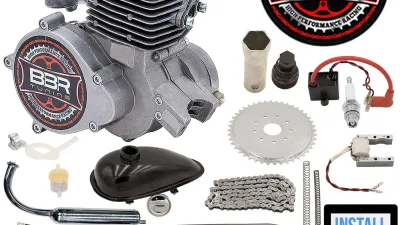
BikeBerry’s listing identifies an engine with Japanese 202 bearings, a reinforced clutch, crank and piston parts, and a copper head gasket. The package also names the CDI, magneto, spark plug, low-profile NT carburetor, chrome muffler, 44-tooth rear sprocket, chain idler, fuel tank, clutch and throttle controls, chain guard, and installation tools.
That is a useful inventory, but it is not proof of a complete, compatible build. The listing says top-end assembly is required. A buyer still needs the correct gasket placement, fastener sequence, torque procedure, cable routing, chainline, fuel-system setup, exhaust clearance, and post-installation inspection.
Similar listings may use “80cc” as a merchant category rather than a standardized measured displacement. Compare exact bore, stroke, cylinder, head, and replacement-part identity instead of relying on the label alone. Our 80cc versus 100cc engine-kit comparison explains why the largest number is not automatically the better choice.
Compare the current BBR V1 and V2 80/100cc layouts by top end, intake, clearance, and service needs.
What makes the Angle Fire the sensible BBR starting point
The Angle Fire does not add the electric starter and wiring of the unavailable Bullet Train listing, the model-specific layout of the V2 80/100cc kit, or the head, intake, carburetor, ignition, and exhaust changes found in BBR’s staged packages. Fewer interacting systems make the parts inventory and troubleshooting path easier to understand.
That simplicity is relative. A gasoline engine still changes loads, vibration, heat, speed, braking demand, and legal classification. A basic kit on an unsuitable bicycle is less defensible than a more complex kit installed in a purpose-built, documented system.
If you are comparing the staged alternatives, read our BBR Stage 1 through Stage 4 comparison before paying for added parts.
Fit questions the product page cannot answer
BikeBerry’s broad compatibility language should be treated as a prompt to measure, not an approval. Before buying, document:
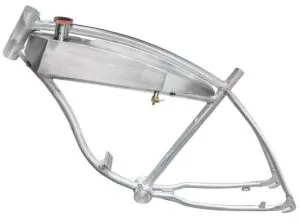
- the frame model, material, tube shapes, condition, and open-triangle dimensions;
- written frame-maker approval for the exact gasoline conversion;
- crank and pedal clearance through a full rotation;
- carburetor, air-filter, fuel-tank, and exhaust clearance;
- rear sprocket, axle, chain, and tensioner geometry;
- wheel, tire, fork, headset, and brake suitability;
- total expected load and intended closed-course surface;
- throttle return, clutch operation, kill switch, and cable routing.
Do not drill, crush-clamp, weld, or grind a bicycle frame without an approved procedure. Our engine-frame compatibility guide covers the evidence to request before choosing a donor bicycle.
Use the kit-specific frame and clearance checklist before treating open space as approval.
Installation and maintenance burden
This is not a bolt-on accessory. Top-end assembly alone introduces head-gasket, fastener, clearance, and sealing decisions. The drive side adds rear-sprocket alignment, chain tension, clearance, and fastener inspection. The fuel and exhaust sides add leak, heat, and routing hazards.
The merchant-hosted reviews include positive reports about starting and basic operation, but they also surface recurring concerns about instructions, mounting work, damaged or inconsistent parts, and the need for modification. Those reviews are useful issue-spotting evidence, not a controlled reliability study.
Plan for a complete pre-ride inspection and frequent early reinspection by a qualified mechanic. Stop immediately for a fuel leak, sticking throttle, brake weakness, loose fastener, wheel play, abnormal vibration, chain interference, overheating, or structural damage.
If an installed engine idles but dies as the throttle opens, follow the shutdown-first fuel, air, intake, carburetor, and drivetrain checks.
Support and return questions to settle first
BikeBerry’s current return policy defines new condition as not installed, fueled, started, or ridden. It also describes an RMA process, buyer-paid return shipping, and a possible restocking fee (BikeBerry return policy). The warranty policy describes part-level diagnosis, photos, exclusions, and buyer responsibility for labor and some shipping (BikeBerry warranty policy).
Before assembly, save the policies and ask which term applies to SKU STK-BEK80-S, what troubleshooting evidence is required, which parts are excluded, and which replacement parts are currently stocked. Do not fuel the engine until the shipment has been inventoried and visible damage or missing parts have been reported.
Legal and road-use limits
BikeBerry’s gasoline-product notice says its kits are not EPA or CARB compliant for on-road or off-road public use and are sold for closed-course competition. A product page, engine-size label, or pedal-equipped frame does not establish public-road legality.
NHTSA has treated self-propelled gasoline motorized bicycles intended for public roads as motor-driven cycles in past interpretations (NHTSA interpretation). State registration, licensing, equipment, insurance, helmet, and operating rules can add further restrictions. Trail and private-property access are separate questions.
Who should consider it
The Angle Fire is worth investigating only for a builder who:
- has confirmed a legal closed-course use;
- has written approval for the host bicycle and complete system;
- can perform or obtain qualified mechanical installation;
- understands two-stroke fuel, ignition, chain, and inspection requirements;
- accepts that merchant speed and reliability claims remain unverified.
It is a poor choice for a first-time rider seeking simple transportation, public-road access, minimal maintenance, or guaranteed fit. A factory-built compliant vehicle is the clearer option in those cases.
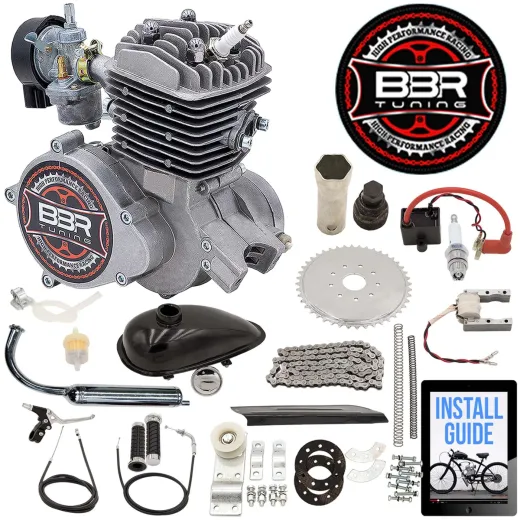
BBR Tuning 66/80cc Angle Fire Bicycle Engine Kit
Review the current BikeBerry listing for availability, specifications, options, and purchase terms.
Affiliate link · Opens BikeBerry in a new tab
Inspect the current BBR Tuning Angle Fire listing
Frequently asked questions
Is the BBR Tuning Angle Fire really 80cc?
Treat 66/80cc as the merchant’s model category unless exact bore and stroke documentation establishes measured displacement. Use exact product and replacement-part identifiers rather than assuming every “80cc” kit is mechanically identical.
Does the Angle Fire fit any 26-inch bicycle?
No universal fit is established. Wheel size alone does not resolve frame-tube shape, engine clearance, mounting loads, crank clearance, chainline, brakes, wheels, tires, or manufacturer approval.
Is it legal on public roads?
Do not assume so. BikeBerry limits its gasoline products to closed-course competition, and federal, state, and local vehicle rules may apply. Confirm the exact use with the responsible agencies before purchase.
Final recommendation
The BBR Tuning Angle Fire is the first current BBR two-stroke kit we would research because it avoids several optional complexity layers. Buy it only after the law, host bicycle, installation, brakes, wheels, tires, fuel system, and maintenance plan are documented. Compare it with the other active choices in our best two-stroke bicycle engine kit shortlist and use the motorized bicycle guide to evaluate the complete system.