BBR V1 vs. V2 80/100cc Bicycle Engine Kits
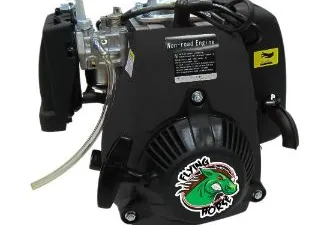
The BBR V1 is the simpler one-piece-top-end kit. Compare it with the V2 reed-valve layout by parts, clearance, service needs, and frame fit.
Choose the BBR V1 when you want the simpler of these two current 80/100cc packages. Its one-piece cylinder and head avoids the V2’s separate head, built-in reed valve, and model-specific intake and ignition layout. Choose the V2 only when those exact features serve a documented build and you have verified the extra clearance, replacement parts, and installation procedure.
Neither kit is a universal fit or a public-road recommendation.
How we compared
Research disclosure: We did not install, ride, or dynamometer-test either kit. This comparison uses the rendered BikeBerry V1 and V2 listings, package specifications, merchant installation guidance, and federal guidance checked July 29, 2026. Merchant performance and fit claims are not independent test results.
V1 versus V2 at a glance
| Detail | BBR V1 | BBR V2 |
|---|---|---|
| Current SKU | FH-BEK100 | FH-BEK100-V2 |
| Top end | One-piece cylinder and head | Separate cylinder and head |
| Listed bore and stroke | 50 mm by 40 mm | 50 mm by 40 mm |
| Intake | Conventional listed intake with NT-style carburetor language | Built-in reed valve and speed carburetor |
| Spark-plug layout | Angled | Vertical |
| Rear drive | 44-tooth sprocket and 415 chain | 44-tooth sprocket and 415 chain |
| Best reason to choose | Fewer model-specific systems | Exact need for the V2 intake and serviceable head layout |
| Main reason to pause | One-piece top-end service and exact-part identity | More clearance and model-specific parts to verify |
BikeBerry describes both as nominal 80/100cc kits and lists a 50 mm bore with a 40 mm stroke. The merchant also identifies the actual displacement as about 78.6 cc. That makes exact model identity more useful than the large number in the product name.
The practical difference
The V1 combines its cylinder and head in one casting. That can reduce the number of top-end sealing interfaces, but it also means the head is not a separately replaceable or swappable part. Confirm the exact cylinder, piston, rings, gasket, spark plug, and fastener procedure before ordering service parts.
The V2 separates the cylinder and head, adds larger listed cooling fins, and uses a built-in reed valve. BikeBerry also lists a speed carburetor and a vertical spark-plug arrangement. Those are meaningful architectural differences, not proof of more power, lower temperature, easier starting, or longer service life.
If your real decision is engine category rather than BBR model, start with our 80cc versus 100cc engine-kit comparison.
Fit may decide before features do
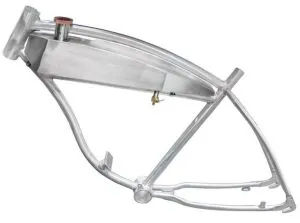
BikeBerry says these kits are intended for many 26-inch V-frame bicycles and gives broad guidance of roughly 9 to 11 inches between the bottom bracket and top tube, with round frame tubes around 25 to 29 mm. Treat those figures as merchant screening guidance, not approval for a bicycle.
Before buying either kit, document:
- written frame-maker approval for the exact conversion;
- frame material, condition, tube shape, diameter, and open-triangle dimensions;
- clearance above the cylinder, head, and spark plug;
- carburetor, air-filter, fuel-tank, and exhaust clearance;
- crank and pedal clearance through a complete rotation;
- rear sprocket, chainline, axle, wheel, and tensioner geometry;
- brake, fork, headset, wheel, and tire suitability;
- exact mounting hardware and an approved torque procedure.
Do not drill, crush, grind, or weld a bicycle frame to make a kit fit unless the frame maker supplies an approved procedure. Use our engine-kit frame compatibility checklist to record the whole system before purchase.
V1 strengths and limits
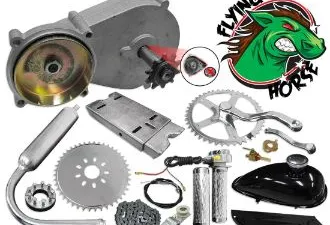
The V1 is the cleaner research choice when no V2-specific feature is required. Its listed one-piece top end, angled plug, 44-tooth sprocket, 415 chain, and 1.5-liter tank create a relatively direct parts inventory.
That does not make it easy or complete. The mount, chainline, controls, fuel system, exhaust, brakes, wheels, tires, and host frame still have to work as one approved system. The one-piece top end also makes exact replacement-part confirmation especially important.
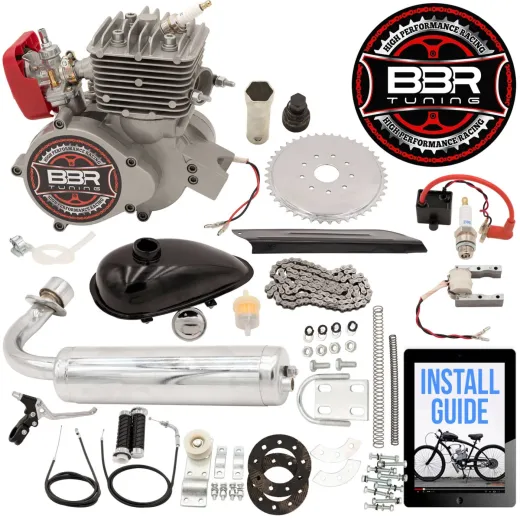
BBR Tuning V1 80/100cc Bicycle Engine Kit
Review the current BikeBerry listing for availability, specifications, options, and purchase terms.
Affiliate link · Opens BikeBerry in a new tab
Inspect the current BBR V1 listing
V2 strengths and limits
The V2 is relevant when a builder specifically needs its separate head or reed-valve layout and can source the matching service parts. The separate head may change service options. The larger fins and vertical plug also change the space that must remain available above and around the engine.
The V2’s added systems create more questions: reed-petal identity, intake sealing, carburetor setup, ignition compatibility, head hardware, gasket identity, and exhaust fit. Resolve them from the current instructions or BikeBerry support before assembly.
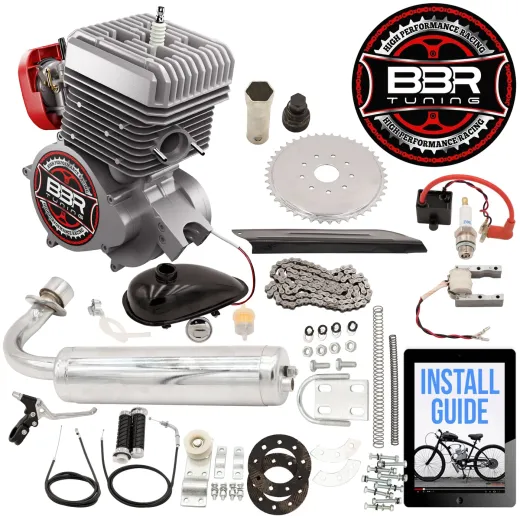
BBR Tuning V2 80/100cc Bicycle Engine Kit
Review the current BikeBerry listing for availability, specifications, options, and purchase terms.
Affiliate link · Opens BikeBerry in a new tab
Inspect the current BBR V2 listing
Installation, support, and legal limits
BikeBerry’s 100cc installation guide is useful for understanding the work sequence, but the instructions for the exact SKU should control. Use qualified mechanical help for any unresolved mount, torque, fuel, ignition, chain, wheel, or brake question.
Stop and shut the engine down for a fuel leak, sticking throttle, ineffective kill switch, weak brake, loose mount, wheel play, chain interference, abnormal heat, structural damage, or unusual vibration. Do not diagnose a running engine near moving drive parts or leaking fuel.
BikeBerry states that its gasoline products are not EPA or CARB compliant for public-road or public off-road use and sells them for closed-course competition. A past NHTSA interpretation also explains why a self-propelled gasoline bicycle intended for public roads may be treated as a motor-driven cycle. State and local rules can add licensing, registration, equipment, insurance, and operating requirements.
Frequently asked questions
Is the V2 automatically better than the V1?
No. The V2 has a different top end, intake, carburetor, ignition, and plug layout. Those differences add options and compatibility questions. They do not independently prove better performance or reliability.
Are these really 100cc engines?
BikeBerry currently uses an 80/100cc product label while listing a 50 mm bore, 40 mm stroke, and about 78.6 cc actual displacement. Compare exact dimensions and part identifiers, not the category name alone.
Will either kit fit any 26-inch bicycle?
No. Wheel diameter does not establish frame approval, mounting geometry, engine clearance, chainline, brake capacity, or wheel and tire suitability.
Verdict
The V1 is our default research choice because it has fewer model-specific systems. The V2 makes sense only when its separate head and reed-valve layout solve an exact requirement that has been verified against the host bicycle. In either case, use the motorized bicycle guide and two-stroke kit shortlist to evaluate the complete build rather than the engine alone.