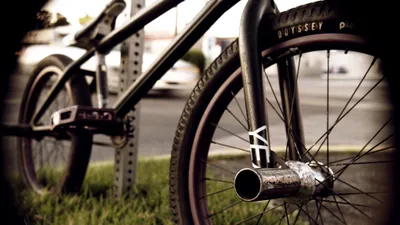
Can You Put Pegs on Any Bike?
No. Bicycle pegs require an approved axle, hub, fork or frame, dropout, and enough thread engagement. Quick-release and thru-axle bikes usually need model-specific systems.

No, you cannot safely put pegs on every bike. Traditional pegs are designed around specific solid axles, hub hardware, dropout shapes, and riding loads. A peg that slips over an axle is not proof that the axle has enough diameter, thread engagement, strength, or manufacturer approval.
Compatibility by axle type
| Bicycle interface | Default answer |
|---|---|
| BMX solid male axle with maker-approved peg | Often compatible after exact size check |
| Female-bolt BMX hub | Requires the hub maker’s matching peg/bolt system |
| Quick-release skewer | Do not substitute a standard peg |
| Modern thru-axle | Only a purpose-designed, maker-approved accessory |
| Coaster-brake or internally geared hub | Confirm axle hardware and reaction-arm requirements |
| Carbon fork or frame | Do not add unsupported peg loads |
Five checks before installation
- Intended use: standing and grinding loads are different from a small passenger footrest or a trailer adapter.
- Axle system: identify male or female axle, diameter, thread pitch, shoulder shape, and nut or bolt specification.
- Thread engagement: the correct fastener must fully engage after the peg and any approved washer are fitted.
- Dropout and hub approval: the frame, fork, axle, bearings, and dropout must be rated for the new bending and impact loads.
- Clearance: spin the wheel and check brakes, chain, derailleur, disc rotor, frame, and foot clearance.
Do not replace a quick-release skewer with hardware-store threaded rod, stack random washers, drill a peg, or leave an axle nut partially engaged.
Front versus rear pegs
Front pegs affect steering clearance and load the fork ends. Rear pegs can interfere with the derailleur, chain, brake, or axle nut. On a BMX built for pegs, the hub and frame maker may specify axle size, peg bore, hub guards, and driver-side clearances. Follow that exact system.
A commuter, mountain bike, or road bike may use superficially similar hardware but have no approval for stunt loads. Adding pegs can also void a frame, fork, wheel, or hub warranty.
Pegs are not passenger seats
Freestyle pegs are not automatically passenger footrests. Carrying a passenger changes the bicycle’s total load, braking, balance, and legal status. Use only a bicycle or cargo system specifically designed and rated for that passenger, with seating and foot protection required by the manufacturer and local law.
Installation and inspection
Use the peg and hub maker’s spacers, anti-rotation features, lubricant or thread treatment, and torque value. After installation, verify that the axle is seated, the wheel is centered, the brake works, and nothing contacts a moving part. Recheck after the first short controlled ride and after any grind or impact.
Our BMX versus mountain-bike guide covers intended use, while the bike tool kit guide explains why axle work calls for the correct wrench and torque information.
Bottom line
Install pegs only when the exact hub, axle, frame or fork, and peg manufacturer approve the combination. If documentation is missing—or the bike uses a quick release—treat it as incompatible until a qualified bicycle mechanic confirms a purpose-built solution.