80cc vs 100cc Bicycle Engine Kits: Which Should You Choose?
An 80cc bicycle engine kit is usually the lower-complexity choice. Compare fit, heat, vibration, parts, braking, legality, and current BBR options.
Choose a conventional 66/80cc kit over a nominal 80/100cc kit unless a documented closed-course requirement justifies the larger package. A 100cc label does not guarantee a better build. It can mean more difficult clearance, cooling, vibration, drivetrain, wheel, and braking decisions, while both categories face the same legal and frame-approval barriers.
The practical difference
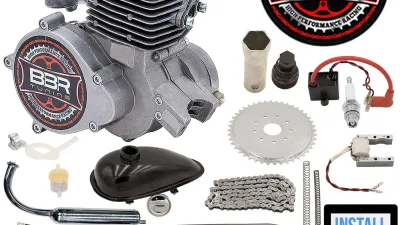
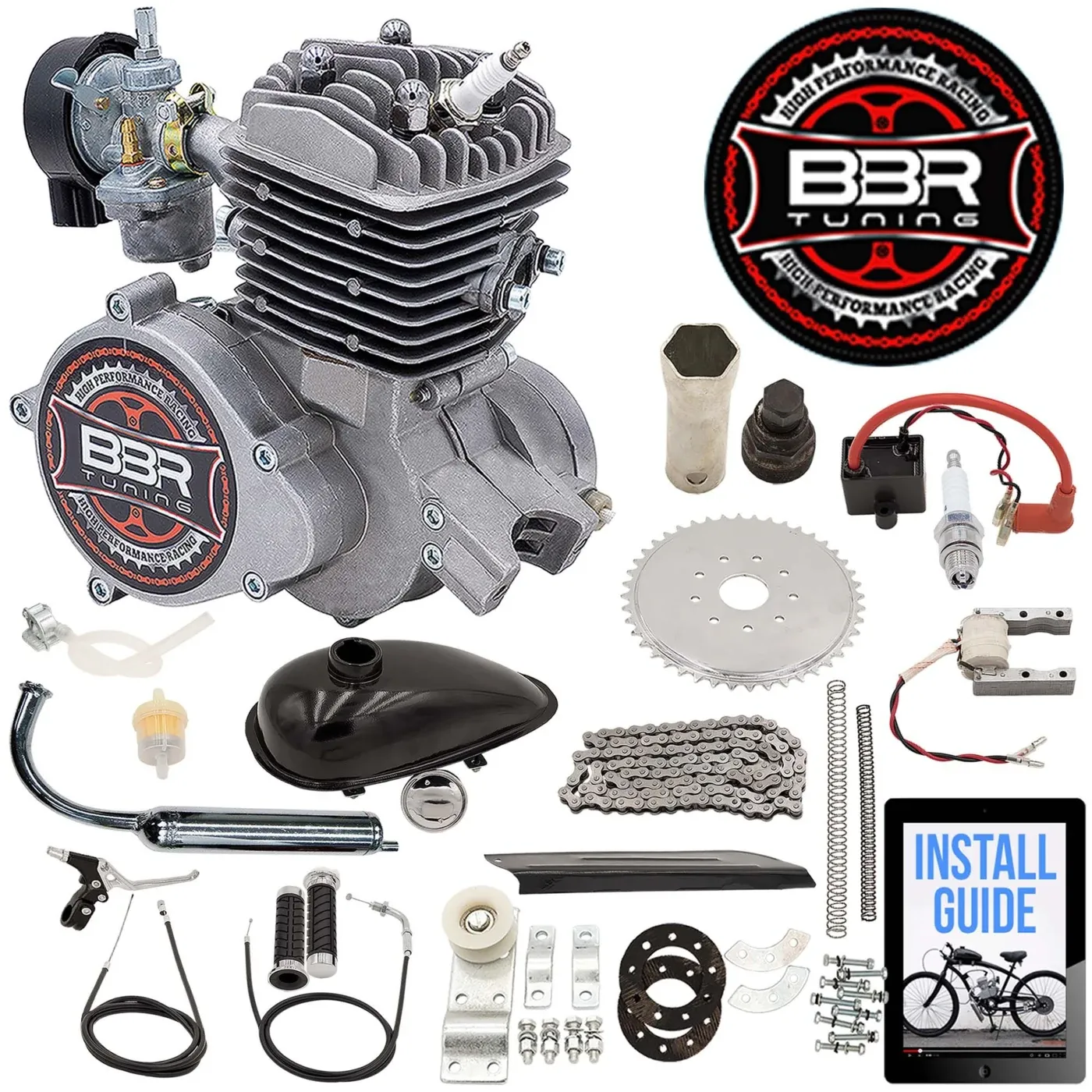
BikeBerry currently sells standard kits under the 66/80cc label and larger V1 and V2 kits under the 80/100cc label. Those names are merchant product categories, not enough information to calculate power or predict speed. Compare exact bore, stroke, cylinder construction, mounting dimensions, carburetor, ignition, exhaust, sprocket, and included hardware.
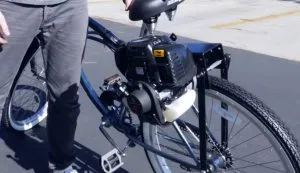
The larger engine is not an upgrade if it forces a poor mount, reduces crank clearance, overloads the bicycle, or creates a chainline that cannot be secured.
Side-by-side decision guide
| Question | 66/80cc kit | 80/100cc kit |
|---|---|---|
| Frame clearance | Usually the first category to measure | Requires a new measurement, not an assumption |
| Heat and vibration | Still substantial for bicycle parts | Potentially greater system concern |
| Parts complexity | Broader conventional category | V1 and V2 parts must be distinguished |
| Braking and wheels | Must be approved for the complete build | Same requirement, with no shortcut for displacement |
| Best reason to choose | Simpler current starting point | Exact documented need and compatible host |
| Poor reason to choose | Seller speed claim | Bigger number or expected top speed |
How we compared
This comparison is based on current merchant documentation, not installation or performance testing. On August 1, 2026, we rechecked the exact BikeBerry listings and their Add to Cart state: STK-BEK80-S for the 66/80cc Angle Fire, FH-BEK100 for the V1, and FH-BEK100-V2 for the V2. We checked exact product identity, availability, listed engine construction, package contents, fit requirements, and support. We did not accept merchant horsepower, torque, speed, easy-installation, or reliability language as independent evidence.
BikeBerry’s own gasoline-product notice says its kits are not EPA or CARB compliant for public-road use and are sold for closed-course competition. Neither engine size avoids that limitation.
Current 66/80cc reference
The BBR Tuning Angle Fire is the simpler comparison point. Its conventional layout makes it easier to inventory the engine, carburetor, ignition, fuel, exhaust, clutch, chain, and sprocket interfaces without the additional V1 versus V2 distinction.
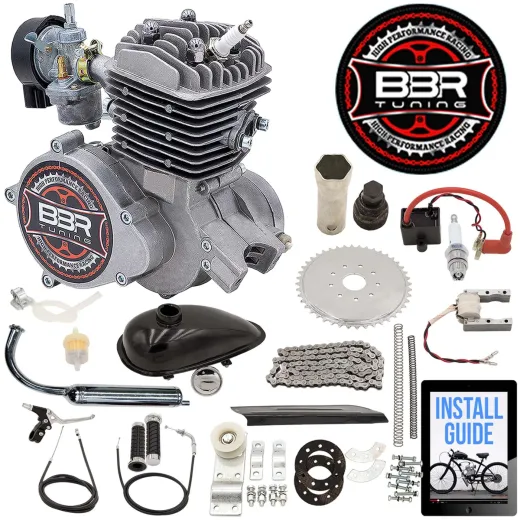
BBR Tuning 66/80cc Angle Fire Bicycle Engine Kit
Review the current BikeBerry listing for availability, specifications, options, and purchase terms.
Affiliate link · Opens BikeBerry in a new tab
Inspect the current 66/80cc Angle Fire kit
This is the first listing we would investigate, not a universal recommendation. Our BBR Tuning Angle Fire review examines its exact package, assembly burden, fit questions, and merchant-review evidence.
Current 80/100cc V1
BikeBerry describes its V1 as a one-piece cylinder and head with a 50 mm bore, 40 mm stroke, NT carburetor, ignition components, balanced crank, and mounting accessories. Use those exact identifiers when ordering replacement parts.
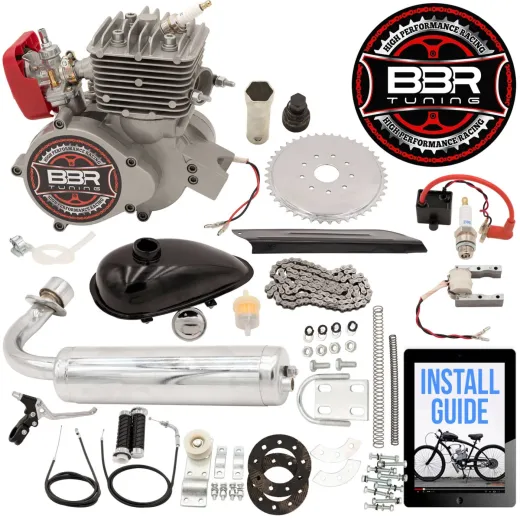
BBR Tuning V1 80/100cc 2-Stroke Motorized Bicycle Kit
Review the current BikeBerry listing for availability, specifications, options, and purchase terms.
Affiliate link · Opens BikeBerry in a new tab
Inspect the current BBR 80/100cc V1 kit
The one-piece top end is a model-specific service consideration. Do not order V2 top-end parts for it without written confirmation.
Current 80/100cc V2
The V2 listing names a two-piece cylinder and head, speed carburetor, vertical spark-plug layout, ignition changes, and the FH-BEK100-V2 product identity. The separate head may change service options, but it does not by itself prove better cooling, performance, or reliability.
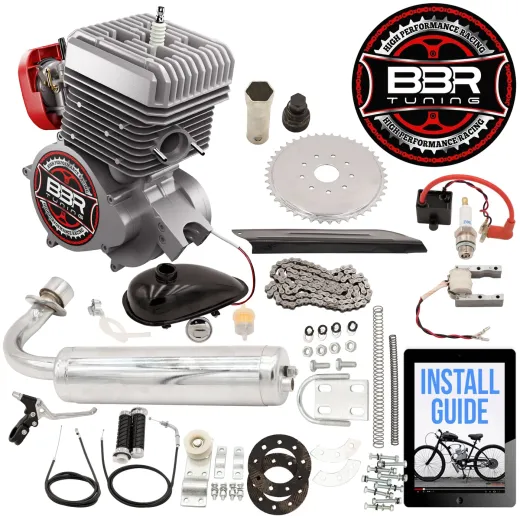
BBR Tuning V2 80/100cc 2-Stroke Motorized Bicycle Kit
Review the current BikeBerry listing for availability, specifications, options, and purchase terms.
Affiliate link · Opens BikeBerry in a new tab
Inspect the current BBR 80/100cc V2 kit
Check vertical clearance above the cylinder and spark plug, access for service, intake routing, and exhaust fit on the exact frame.
Compare the current V1 and V2 parts, clearance, and service differences before treating either 80/100cc label as a complete specification.
Why speed should not decide
Top speed depends on far more than displacement. Engine state, gearing, wheel size, rider and cargo mass, grade, wind, altitude, fuel mixture, installation, and mechanical condition all matter. Our guide to 80cc motorized-bicycle speed explains why a seller range is not a guarantee.
Higher speed also raises the importance of braking, tire condition, wheel integrity, steering stability, and protective equipment. Never use a claimed performance figure to exceed a component rating or legal limit.
Measure before choosing
Record the following for the actual bicycle:
- open frame-triangle dimensions;
- tube diameters, shapes, material, and condition;
- crank and pedal clearance through a full rotation;
- carburetor and air-filter space;
- exhaust path and heat clearance;
- rear dropout, axle, sprocket, chain, and tensioner geometry;
- tire and wheel specifications;
- brake type and manufacturer limits;
- total expected mass and intended surface.
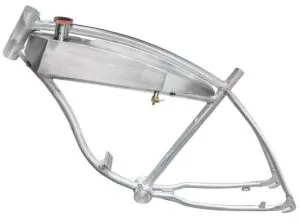
Use the engine-ready frame guide before treating a merchant’s broad fit statement as approval. Our kit-specific compatibility worksheet adds exact mount, service-clearance, chainline, control, and finished-system checks.
Verdict
The 66/80cc category is the better default research path because it avoids some of the size and model-specific complexity of the 80/100cc V1 and V2 kits. Choose a 100cc-labeled kit only after documenting a compatible host, a real use-case requirement, legal closed-course operation, and qualified installation. For current options beyond these three, see our two-stroke bicycle engine kit shortlist and use the motorized bicycle guide to evaluate the rest of the system.