Bicycle Engine Kit Frame Compatibility and Clearance Guide
A bicycle engine kit needs frame-maker approval, sound round tubes, enough engine clearance, correct chainline, and brakes and wheels suited to the complete build.
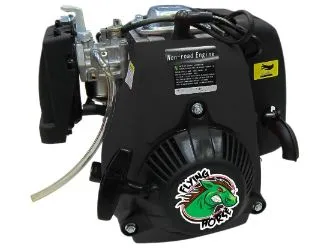
Table of Contents
- Stop before buying if any of these apply
- The measurements to record
- What current merchant fit claims mean
- Frame material and tube shape
- Engine and service clearance
- Rear sprocket and chainline
- Brakes, wheels, tires, and steering
- Fuel, exhaust, and controls
- Legal use is part of compatibility
- Final compatibility checklist
A bicycle engine kit is compatible only when the frame maker approves the conversion, the frame is structurally sound, the exact engine and mount fit without prohibited modification, the drive can be aligned, and the brakes, wheels, tires, fork, and headset are suitable for the completed vehicle.
A 26-inch wheel and an open V-frame are useful screening details. They are not proof of compatibility.
The current mag-wheel guide turns the wheel, axle, brake, sprocket, and tire interfaces into a pre-purchase check. The chopper guide separates ordinary pedal cruisers from a documented motor-ready frame. Verify the exact ETRTO tire, rim width, load, pressure, clearance, and intended use as part of the finished system.Stop before buying if any of these apply
Do not proceed when:
- the bicycle or frame maker prohibits motor installation or will not approve it;
- the frame has a crack, dent, severe corrosion, damaged weld, loose insert, or prior unapproved repair;
- the kit requires drilling, crushing, grinding, bending, or welding without an approved procedure;
- the mount lands on a cable stop, bottle boss, butted transition, weld, or shaped tube it was not designed for;
- engine, spark plug, carburetor, filter, exhaust, fuel tank, crank, or pedal clearance cannot be established;
- the rear sprocket and engine sprocket cannot share a secure chainline;
- the brake, wheel, tire, fork, headset, or axle limits are unknown;
- public-road legality or the permitted riding location is unresolved.
Have a qualified bicycle mechanic and, where needed, a qualified engine-kit installer inspect the proposed system before assembly.
The measurements to record
Create a worksheet for the exact frame and kit. Record:
| Area | What to measure or verify |
|---|---|
| Main triangle | Usable height, length, and width at every engine contact point |
| Frame tubes | Material, round or shaped profile, outside diameter, wall or butting information if available |
| Engine package | Mount spacing, overall height, width, intake, filter, plug, exhaust, and starter envelope |
| Pedal system | Crankarm and pedal path through a full rotation |
| Fuel system | Tank-mount area, valve access, hose path, heat separation, and leak inspection access |
| Rear drive | Sprocket attachment, chainline, axle, dropout, tire, stay, and tensioner clearance |
| Controls | Throttle return, clutch or transmission control, kill switch, cable bends, and steering movement |
| Chassis | Fork, headset, wheels, tires, brakes, total mass, and intended surface |
Photograph the frame from both sides and the front, then mark every proposed mount and clearance. Save the exact kit SKU and the instructions used.
What current merchant fit claims mean
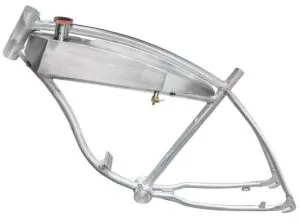
BikeBerry’s current V1 and V2 80/100cc listings say the kits are intended for many 26-inch V-frame bicycles. The pages give broad guidance of about 9 to 11 inches from the bottom bracket area to the top tube and round tubes around 25 to 29 mm.
Those measurements are a first filter only. They do not establish frame strength, tube-wall suitability, mount load, crank clearance, chainline, brake capacity, or bicycle-maker approval. Compare the exact kit through our BBR V1 versus V2 guide before using any package dimensions.
BikeBerry’s two-stroke installation guide also discusses open-frame space and tube diameter. Use the instructions for the exact product instead of treating a general guide as a torque or fit specification.
Frame material and tube shape
Material alone does not approve or reject a conversion. Steel, aluminum, carbon, and titanium frames use different tube shapes, wall structures, joints, heat treatments, and load assumptions. A generic clamp can create concentrated loads or crush a tube even when its nominal diameter seems correct.
Get written guidance from the frame maker. Do not assume a steel frame permits drilling or welding. Do not clamp an adapter to carbon unless the frame and adapter makers explicitly approve the exact interface. Do not reshape a mount around an oval, hydroformed, butted, or tapered tube.
The frame also needs enough straight, unobstructed tube length for the approved mount. A clamp overlapping a weld, boss, cable guide, or diameter transition may not seat or load as intended.
Engine and service clearance
Clearance is more than fitting the engine into the triangle once. Leave room to:
- install and remove the spark plug with the specified tool;
- inspect and service the head or top end;
- remove and clean the air filter;
- operate the fuel valve;
- route fuel line away from heat and abrasion;
- remove the exhaust using the specified hardware;
- turn the handlebar fully without pulling a cable;
- rotate both crankarms and pedals without contact.
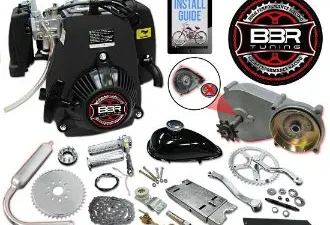
Four-stroke kits may add a wider reduction transmission and pull starter. Two-stroke layouts may need extra carburetor, filter, clutch-cable, and exhaust space. Our 2-stroke versus 4-stroke comparison maps those package differences.
Rear sprocket and chainline
The drive chain must run in the same plane at the engine and rear sprocket. A visible sideways angle, changing tension, tire or stay contact, loose sprocket, or poorly supported tensioner is a stop condition.
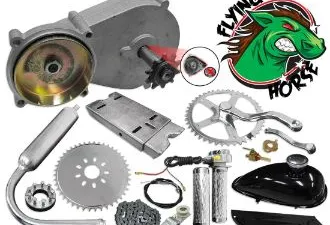
Verify the sprocket attachment system against the wheel and hub. A generic rag-joint mounting method can load spokes and place the sprocket off center. Do not assume mag wheels, disc-brake mounts, freewheel threads, or hub flanges can accept a drive sprocket.
Turn the rear wheel and crank slowly by hand before starting the engine. Check the tightest chain point, axle security, tire clearance, chain guard, and every fastener. The motorized-bicycle chain-tensioner guide explains why an idler cannot correct a fundamentally wrong chainline.
Brakes, wheels, tires, and steering
An engine kit changes mass, speed potential, vibration, heat, and load cycles. The original bicycle’s brakes and wheels may have been designed for lower energy and different use.
Verify:
- brake condition and the maker’s intended use;
- adequate front and rear braking control where required;
- rim or rotor compatibility and heat condition;
- spoke tension, rim condition, hub play, axle retention, and tire ratings;
- fork and headset condition;
- handlebar, stem, grips, throttle, and cable security.
Do not use a claimed engine speed as permission to exceed a bicycle component rating or legal limit.
Fuel, exhaust, and controls
The tank needs an approved mount that does not damage the top tube. Fuel hose must avoid sharp bends, rubbing, hot surfaces, and moving parts. The exhaust needs separation from the frame, tire, cables, fuel system, and rider.
The throttle must snap closed from every handlebar position. The kill switch must stop the engine. Route clutch, throttle, brake, and electrical lines so full steering movement does not pull, pinch, or abrade them.
Never start or operate the build with a fuel leak, sticking throttle, ineffective kill switch, chain interference, loose engine, weak brake, wheel play, or structural concern.
If a completed engine idles but dies as the throttle opens, use the shutdown-first fuel, air, intake, carburetor, ignition, and drive checks.
Legal use is part of compatibility
BikeBerry says its gasoline products are not EPA or CARB compliant for public-road or public off-road use and sells them for closed-course competition. NHTSA has also addressed public-road gasoline bicycles as possible motor-driven cycles in a past interpretation.
Confirm the exact federal, state, local, land-access, registration, licensing, insurance, lighting, equipment, helmet, and operating requirements before purchase. A mechanically fitting engine is not compatible with an illegal intended use.
Final compatibility checklist
Proceed only when you can answer yes to each question:
- Is the exact conversion approved for this frame?
- Is the frame undamaged and suitable at every mount?
- Does the exact engine package fit with service clearance?
- Can both pedals and the handlebar move through their full ranges?
- Is the rear drive aligned and secured without interference?
- Are the brakes, wheels, tires, fork, headset, and axles suitable?
- Are fuel, exhaust, electrical, and control routes protected?
- Are the instructions, torque values, and replacement parts identified?
- Is qualified installation and inspection available?
- Is the intended operation legal and permitted?
Use the motorized bicycle guide to document the remaining systems. If any answer stays uncertain, do not buy or start the kit.