Chain Wax vs. Chain Lube: Cleanliness, Wear, and Maintenance
Compare bicycle chain wax and liquid lube by preparation, cleanliness, wet-weather use, wear checks, reapplication, and the routine your ride permits.
Table of Contents
- Wax vs. liquid lube at a glance
- What is the difference between chain wax and chain lube?
- When is wax the better fit?
- When is liquid lube the better fit?
- How do the systems affect cleanliness and wear?
- Can you mix wax and liquid lube?
- A conservative setup and maintenance workflow
- Is wax better for wet weather?
- Does wax make a chain last longer?
- Frequently asked questions
- How we compared
- Bottom line
- Sources
Choose chain wax when you can do the preparation and keep the chain clean and dry enough for the product’s instructions. Choose a liquid bicycle chain lube when quick application, wet-weather retention, or easier in-place maintenance fits your conditions. Neither option is automatically faster, quieter, cleaner, or longer lasting for every bicycle. The chain maker, lubricant maker, weather, dirt, drivetrain, and maintenance time decide the useful choice.
Park Tool’s Guide to Bicycle Lubricants and Compounds, retrieved September 2, 2026, describes wet and dry lube categories and says wax-based lubricants are another option. SILCA’s Wax vs Oil guide, retrieved September 2, 2026, separates immersion wax, drip wax, and oil application. Those product and tool-maker descriptions are useful for a decision framework, not a universal performance ranking.
Key Takeaways
- Wax has a higher preparation commitment. A liquid lube is usually simpler to apply on the bicycle.
- A wax system depends on a clean chain and product-specific preparation. Do not put wax over an oily chain unless the wax maker says how to prepare it.
- Liquid lube comes in formulas for different conditions. Wet formulas may suit rain, while dry formulas are intended for drier, dustier conditions according to the maker.
- Both systems need cleaning, inspection, and reapplication. No lubricant repairs a worn, cracked, stiff, or incorrectly sized chain.
- Keep any lubricant away from disc rotors, brake pads, rim tracks, tires, and e-bike electrical connectors.
Wax vs. liquid lube at a glance
| Decision | Chain wax | Liquid chain lube |
|---|---|---|
| Preparation | Usually needs thorough degreasing; hot wax also needs a heating and dipping process | Usually applied to a clean chain at the rollers, then excess is wiped away |
| Outside feel | Dries to a wax film when the product is ready | Can remain wet or tacky, depending on formula |
| Dirt management | A dry film can reduce the amount of loose dirt held on the outside, but only when the chain and drivetrain are prepared correctly | Wet formulas can retain more grit; dry formulas have a different balance of dirt attraction and water resistance |
| Rain and puddles | Product-specific; water can shorten service life or require a clean and reapplication | Wet-weather formulas may remain in place longer, but still need cleaning after contamination |
| Maintenance style | More work at setup; can suit a rider who accepts a repeatable chain-removal or drip-wax routine | Easier to top up in place; excess and dirt still need to be wiped and cleaned |
| Best deciding factor | Willingness to prepare and maintain a clean system | Conditions, access to cleaning, and need for quick service |
The table compares maintenance choices, not measured wattage, chain life, or noise. Product instructions take priority over a category label.
What is the difference between chain wax and chain lube?
Chain wax is a wax-based lubricant that can be applied as melted wax or as a liquid wax emulsion. Hot-melt wax requires removing the chain or using the product’s supported system, preparing the chain, heating the wax as directed, and allowing the chain to cool. Drip wax is applied to the chain as a liquid that dries into a wax film. The two forms are related but have different equipment and preparation requirements.
Liquid chain lube is an oil-based or synthetic liquid designed to reach the chain’s moving interfaces. It is commonly applied to a clean chain, allowed to penetrate as directed, and wiped on the outside. It also comes in wet, dry, ceramic, and other product categories. The name on a bottle does not reveal whether it is compatible with an existing wax film or whether it is suitable for your conditions.
The chain-cleaning guide explains why cleaning and drying come before a new lubricant. Household cleaner is not automatically safe for a chain, bearing, brake, paint, or e-bike.
When is wax the better fit?
Wax can fit a rider who values a dry-feeling drivetrain and is willing to do the preparation the product requires. It can also fit a rider who has a repeatable way to remove or clean the chain and can keep the wax system separate from oil products.
SILCA describes hot wax as a process that starts with stripping factory grease, followed by heating and dipping. The same guide describes drip wax as requiring a fully stripped chain and drying time. Treat those steps as SILCA’s instructions for its products, not as a universal temperature, wait time, or preparation formula for every wax.
Wax may be inconvenient when the bicycle is repeatedly exposed to rain, road spray, mud, or salt and the rider cannot clean and dry the chain. A wax label cannot override the product’s wet-weather limitations. The winter chain-care guide covers the cleaning and drying decisions that matter in cold, wet conditions.
When is liquid lube the better fit?
Liquid lube can be the better fit when you need to service a chain on the bicycle, expect changing weather, or want a formula described by its maker for wet or dry conditions. Park Tool describes wet lubricants as higher-viscosity products that perform well in humid or rainy climates and dry lubricants as generally attracting less dirt in dry, dusty climates. Those are categories, not guarantees for a particular bottle or route.
A wet lube can stay on a wet ride better than a dry formula, but an excess film can hold grit. A dry formula may leave less outside residue in dusty conditions, but water can remove it more quickly. Follow the label and inspect the chain instead of treating a “wet” or “dry” name as a service interval.
Do not use household penetrating oil as a regular bicycle chain lubricant. Park Tool says common WD-40-type penetrating oil is not an ideal regular chain lubricant. The what can I use to lubricate my bike chain guide explains the distinction between a purpose-made chain product and a temporary household substitute.
How do the systems affect cleanliness and wear?
Cleanliness depends on the whole chain system. A clean, dry chain with the correct amount of lubricant can stay cleaner than a dirty chain carrying another product. A wet film can collect dust and grit, while a dry wax film can shed some outside debris. These observations describe maintenance behavior, not a guaranteed wear rate.
Chain wear occurs at internal pin, roller, and plate interfaces. Surface appearance alone cannot tell you whether the chain has reached its service limit. The chain-wear guide covers measurement tools and why the chain maker’s limit takes priority. A lubricant cannot reverse elongated or damaged chain components.
Check the chain before changing lubricant. Look for cracked plates, damaged pins, stiff links, deep corrosion, a missing roller, or a connecting link that does not seat. Replace or professionally assess damaged parts. If a worn chain has already damaged the cassette or chainrings, the cassette replacement guide addresses that separate repair.
Can you mix wax and liquid lube?
Do not mix systems casually. SILCA says oil and wax are not compatible on the chain surface because wax will not adhere properly over oil and oil can sit on wax. The exact transition method depends on the wax maker’s preparation instructions.
If you change from oil to wax, identify the new wax product, remove the chain if required, and follow its full cleaning and preparation process. If you change from wax to oil, clean the chain as the oil maker requires and accept that the original wax process no longer describes the surface. Do not add an oil top-up to a waxed chain as an experiment on a bicycle you need to ride home.
A conservative setup and maintenance workflow
1. Identify the drivetrain
Record the chain model, speed, chainring and cassette, connector, and whether the bike has a derailleur or a single-speed system. The lubricant does not correct a chain that is too wide, too narrow, too long, too short, or incompatible. Use the bike drivetrain maintenance hub for the complete inspection path.
2. Read both labels
Check the chain-lube or wax instructions for cleaning, drying, application location, cure or wait guidance, wet-weather use, and storage. Check the chain and bicycle maker’s warnings. Do not copy a hot-wax temperature, drip count, reapplication distance, or solvent method from another product.
3. Protect braking and electrical parts
Remove or shield the wheel when practical. Keep cleaner and lubricant away from disc rotors, brake pads, rim tracks, tires, belts, suspension seals, and e-bike connectors. If a brake surface may be contaminated, stop riding and follow the brake maker’s cleaning or replacement procedure.
4. Clean and dry the chain
Remove loose grit, use a bicycle-compatible cleaner as its label directs, rinse only when the product and bicycle permit it, and dry the chain fully. Dispose of used solvent according to local rules. Do not spray high-pressure water into bearings or e-bike parts.
5. Apply one product correctly
For liquid lube, apply the label-directed amount to the moving chain interfaces, turn the cranks slowly, allow penetration if specified, and wipe away outside excess. For drip wax, follow its cleaning and drying process before applying it. For hot wax, use the maker’s supported heating and immersion equipment. Do not create a home hot-wax process from an unverified temperature or container.
6. Verify the result
Rotate the cranks by hand and listen for a stiff link, scrape, or abnormal noise. Shift without load through the permitted gears. Check that no product reached a braking surface and that the chain remains on the sprockets. Stop for chain skipping, a chain drop, a damaged link, or a brake that feels different.
Is wax better for wet weather?
Not automatically. A product made for rain may remain useful in wet weather, but the product maker’s wet-weather instructions control. Water can remove or shorten the service life of a wax film, while wet lube can retain grit and demand more cleaning. The best choice is the system you can clean, dry, and reapply correctly for the route.
Does wax make a chain last longer?
Do not promise a lifespan from the lubricant category alone. Chain life depends on chain quality, contamination, alignment, load, shifting, cleaning, and the maker’s service limit. SILCA presents cleanliness and friction as reasons it prefers wax for many uses, but that is a vendor position and not a matched independent durability test. Measure wear and replace the chain according to the relevant maker.
Frequently asked questions
Can I put wet lube over chain wax?
Do not do so unless the wax or lube maker gives a compatible procedure. Oil and wax can interfere with each other on the chain surface. Clean and transition according to the product instructions.
Is dry lube the same as wax?
No. “Dry lube” is a product category that may use a carrier and a film that behaves differently from a hot-melt or drip-wax system. Read the label and do not infer its preparation or compatibility from the word dry.
Should I wax a chain on an e-bike?
Only if the chain, lubricant, drivetrain, and e-bike maker permit the maintenance method. Keep all cleaner and lubricant away from brakes and electrical parts, and have a qualified technician assess a high-load or modified drivetrain when its chainline or components are uncertain.
How often should I reapply either product?
Use the product maker’s condition-based guidance and inspect the chain. Rain, grit, washing, noise, dryness, and contamination can change the interval. Do not adopt a mileage number from another product or rider.
Is wax quieter than oil lube?
A clean, correctly lubricated chain may sound different from a dry or contaminated chain, but there is no universal noise result. A new noise after changing products is a reason to inspect chain condition, application, chainline, and drivetrain compatibility.
How we compared
This is a research-based maintenance comparison, not a controlled efficiency, noise, wear, wet-weather, or durability test. DataForSEO research on September 2, 2026 showed commercial comparison results, product pages, videos, and forum discussions. Park Tool’s lubricant guidance and SILCA’s wax-versus-oil explanation were used to define preparation and condition trade-offs. Vendor claims about longevity, efficiency, mileage, or product superiority were not converted into universal results.
The product examples below are listing and specification references, not a hands-on lubricant comparison. Match the product’s stated condition guidance to the chain maker’s requirements, prepare the chain as directed, and keep all lubricant away from braking surfaces.

Wax-based lube example
Muc-Off Dry Chain Lube, Wax-Based Bike Chain Oil for Bicycle, 120ml
A wax reference when the product instructions and riding conditions agree
Selected from the verified Muc-Off listing. Do not infer universal mileage or efficiency from the product page.
Best for: Riders whose routine suits a wax-based product for dry or dusty conditions
Key specifications: Listing identifies a 120 ml wax-based formula for dry and dusty conditions and all-bike use
Trade-off: Wax-based maintenance still depends on chain preparation, cleaning, and reapplication
Check price on Amazon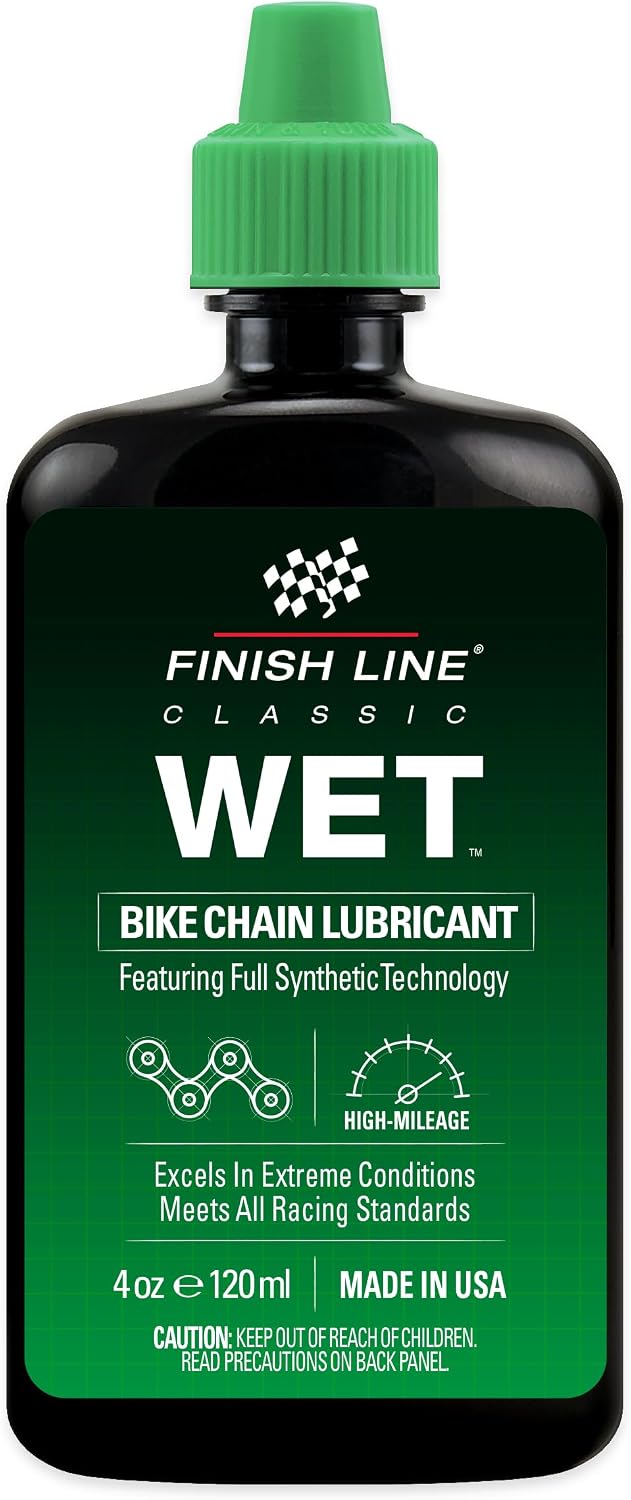
Wet lube example
Finish Line Wet Bike Chain Lubricant 4 fl oz
A liquid-lube reference when wet-weather protection and regular cleaning fit the routine
Selected from the verified Finish Line listing. Apply only as directed and protect all brake surfaces.
Best for: Riders whose routine includes wet, muddy, or high-spray conditions
Key specifications: Listing identifies a 4 fl oz wet-style bicycle chain lubricant for road, mountain, gravel, and cyclocross use
Trade-off: A wet formula can attract contamination when the chain is over-lubricated or left dirty
Check price on AmazonBottom line
Choose wax for a clean-system routine you can prepare and maintain, or choose liquid lube for the conditions and service access it supports. Clean and dry the chain, use only the product’s instructions, protect braking surfaces, and measure chain wear separately. If the drivetrain is damaged, mixed, or high-load, repair the mechanical problem before comparing lubricants.
Sources
- Park Tool, “The Park Tool Guide to Bicycle Lubricants and Compounds,” retrieved September 2, 2026, https://www.parktool.com/en-int/blog/repair-help/the-park-tool-guide-to-bicycle-lubricants-and-compounds
- Park Tool, “How to Clean and Lubricate a Chain,” retrieved September 2, 2026, https://www.parktool.com/en-int/blog/repair-help/chain-cleaning-with-a-park-tool-chain-scrubber
- Park Tool, “When to Replace a Worn Chain,” retrieved September 2, 2026, https://www.parktool.com/en-us/blog/repair-help/when-to-replace-a-chain-on-a-bicycle
- SILCA, “Wax vs Oil: What’s Best For Your Bike’s Chain?,” retrieved September 2, 2026, https://silca.cc/blogs/silca/chain-lub-wax-vs-oil
- Shimano, “General Operation,” retrieved September 2, 2026, https://si.shimano.com/en/pdfs/dm/GN0001/DM-GN0001-26-ENG.pdf