Do You Need a Torque Arm for an E-Bike Conversion Kit?
A hub-motor e-bike conversion may need a torque arm. Match the exact axle, dropout, frame or fork, motor, arm, anchor, hardware, and maker instructions.
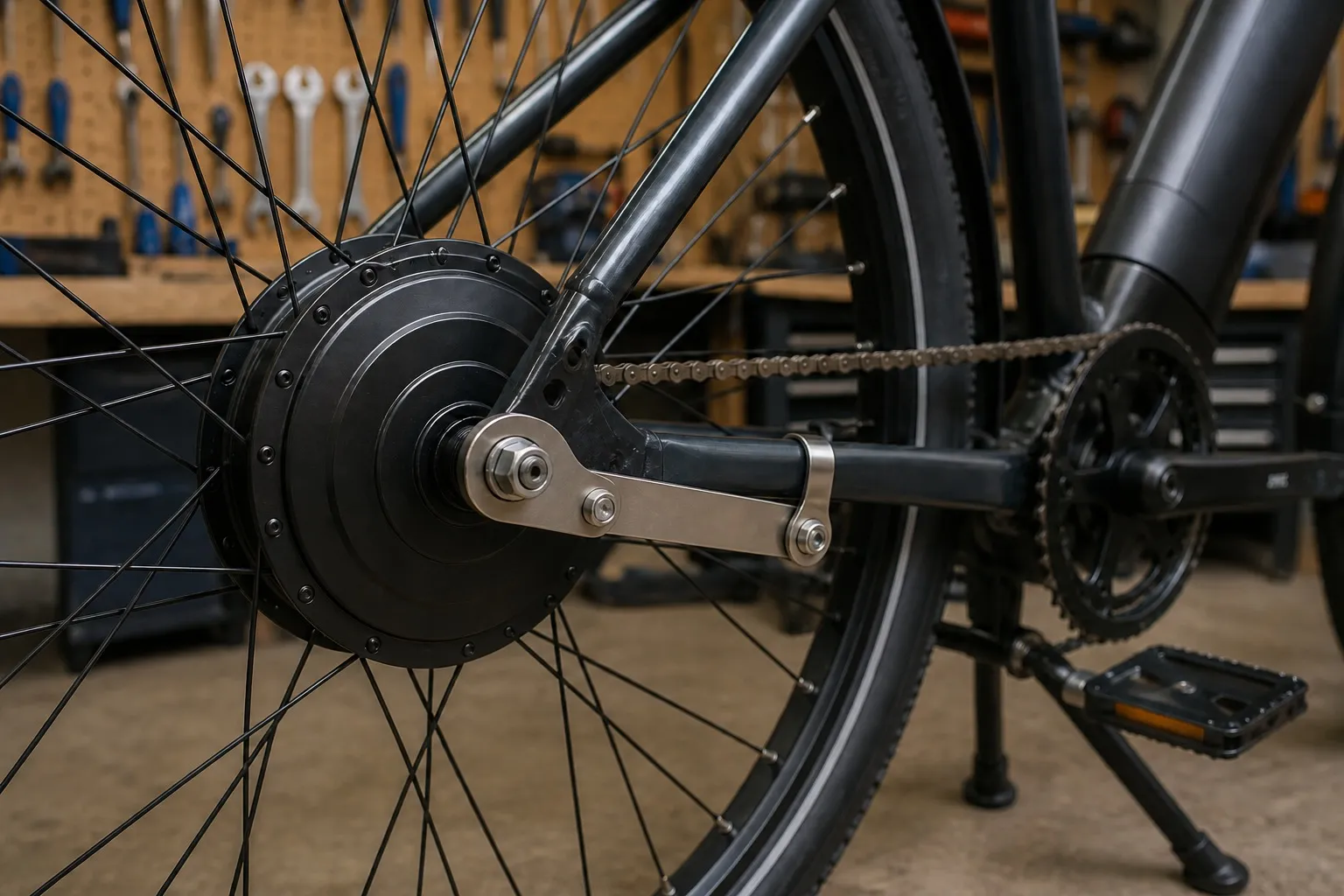
Table of Contents
- Why a hub-motor axle tries to rotate
- Use this decision table
- Front and rear installations are not interchangeable
- Match the exact axle interface
- Match the anchor and rotation direction
- A torque arm cannot repair damage
- A torque arm does not approve the conversion
- Inspect before every early ride
- How many torque arms do you need?
- Frequently asked questions
- Bottom line
- Sources
You need a torque arm for an e-bike conversion when the exact hub-motor maker requires one for that axle, dropout, frame or fork, power system, or regenerative-braking setup. Some engineered motor and frame systems use a different approved anti-rotation interface. A generic arm never makes an incompatible fork, frame, axle, or motor safe.
This is a research-based safety guide, not a universal installation procedure or hands-on test. Use the instructions for the exact motor, torque arm, bicycle, and hardware. Stop if any maker prohibits the conversion or if the required retention system cannot fit without modifying a safety-critical part.
The electric bike conversion kit guide provides a broader system-level compatibility screen before you assess a torque arm.
Why a hub-motor axle tries to rotate
When a hub motor turns the wheel forward, an equal and opposite reaction acts on the axle. Many conversion hubs use a solid axle with flats that engage a slotted dropout. If that interface cannot restrain the reaction, the axle can rotate in the slot.
Grin Technologies explains that axle spinout can deform or break a dropout, damage the motor cable, and allow wheel release (Grin torque-arm guidance). A torque arm fits the motor axle and transfers reaction farther into a compatible frame or fork anchor. That does not remove the load; it changes the load path.
Use this decision table
| Question | Continue only when | Stop when |
|---|---|---|
| Motor | Exact maker identifies the axle and retention system | Motor model, axle size, flats, cable exit, or instructions are unknown |
| Bicycle | Frame or fork maker permits the exact hub conversion | Carbon, suspension, cast, thin, damaged, or altered part lacks approval |
| Dropout | Axle seats fully and hardware lies flat as documented | Slot is shallow, spread, cracked, gouged, misaligned, or obstructed |
| Torque arm | Exact model matches axle, rotation direction, side, and anchor | “Universal” shape is assumed to fit or requires forced alignment |
| Hardware | Washers, nuts, bolts, clamps, eyelets, and torque values are specified | Improvised spacers, partial threads, or unsupported fasteners are needed |
| Inspection | Maker provides initial and recurring checks | No recheck interval or fault response is available |
If one row remains unresolved, do not power the motor. A qualified bicycle or e-bike mechanic can inspect fit and assembly, but cannot override a manufacturer’s prohibition or invent missing limits.
Front and rear installations are not interchangeable
A front hub applies reaction at the fork dropouts and adds motor mass to the steering assembly. Fork material, construction, axle orientation, brake clearance, fender eyelets, cable routing, and wheel retention all matter. Do not place a generic solid-axle motor into a suspension fork, carbon fork, thru-axle fork, or delicate cast dropout because the nominal width seems close.
A rear hub acts at the frame dropouts and must also clear the cassette or freewheel, derailleur, brake, chainstay, and motor cable. Rear dropouts may look more substantial, but appearance does not establish a load rating. Verify the exact system on either end.
Our front versus rear hub-motor guide compares those structural and service trade-offs. The torque-arm decision starts only after the motor location itself is approved.
Match the exact axle interface
Record the axle diameter, flat-to-flat dimension, thread, cable-exit side, washer stack, nut, and specified torque. The torque-arm plate or insert needs the correct fit on the flats. Too much play permits rotation before the arm carries load. A plate that will not seat is also wrong.
Do not file an axle, arm, fork, or dropout unless the exact maker provides a written procedure. Do not omit a keyed washer, anti-rotation washer, spacer, or retention part. “Close enough” geometry can place a nut on an edge, reduce thread engagement, pinch a motor cable, or prevent the axle from reaching the bottom of the slot.
The conversion kit wattage and battery-voltage guide explains why a voltage or power label cannot replace the complete motor and battery compatibility record.
The safe sequence is evidence first, hardware second.
Match the anchor and rotation direction
The arm must oppose the axle’s actual reaction and transfer it into an approved anchor. Eyelet-mounted, band-clamped, and integrated designs have different parts and limits. Regenerative braking can reverse the torque direction, so a system designed only for forward drive may not be appropriate.
Grin’s current guidance warns that an arm mounted on the wrong side of a front fork can encourage the axle to move out of the dropout. Use the exact diagram for the exact model. Never mirror a photo, copy another bicycle, or choose a side solely for appearance.
Every fastener should clamp supported parts squarely. Stop when an arm floats away from the frame, a clamp sits on a taper or cable, an eyelet is not approved for the load, or the assembly pulls the axle out of full seating.
A torque arm cannot repair damage
Inspect the dropout and surrounding frame or fork before installation. Look for cracks, spreading, rounded slot faces, gouges, corrosion, paint movement, bent parts, and previous filing. Check wheel alignment and confirm that the axle seats as designed on both sides.
Do not install an arm as a patch over a spun axle or damaged dropout. Remove the wheel from service and have the exact part assessed under the bicycle and motor makers’ criteria. Replacement may be the only safe outcome.
A torque arm does not approve the conversion
The bicycle still needs approval for the hub motor, added mass, brake setup, wheel, tire, battery, controller, wiring, and intended use. CPSC guidance urges consumers to use micromobility products certified to applicable consensus standards and to use the supplied charging equipment (CPSC micromobility guidance). System certification is not permission to install one component into any bicycle.
Legal classification also varies with the finished vehicle and jurisdiction. Confirm equipment, power, speed, operation, registration, and access rules with the responsible agencies. A torque arm is mechanical retention, not legal approval.
The any-bike conversion compatibility guide covers the frame, fork, wheel, brake, battery, and control checks that remain after the torque-arm decision.
Inspect before every early ride
After assembly by the documented method, rotate the wheel by hand and check brake, tire, frame, fork, fender, cable, and arm clearance. Confirm the motor cable has a protected path through full steering and suspension movement where applicable.
Before applying power, verify:
- axle fully seated on both sides;
- correct washers and hardware in the specified order;
- axle nuts and arm fasteners tightened to documented values;
- arm and anchor square, supported, and free of play;
- brake alignment and wheel rotation;
- motor cable protected from twist, pinch, and abrasion;
- no crack, spreading, gouge, or new witness mark.
Test first in a controlled area away from traffic. Stop immediately for a click, shifting plate, loose clamp, changed wheel alignment, motor-cable movement, brake rub, steering change, or visible dropout movement. Follow the maker’s initial recheck interval and inspect again after wheel removal, a flat repair, impact, or fastener service.
How many torque arms do you need?
There is no universal number. The motor maker’s instructions, axle design, arm strength, dropout construction, power system, and regenerative braking determine the approved arrangement. One robust model-specific arm may be designed for a system where two thin generic plates are not.
Do not double unverified parts as a substitute for one correct system. Extra hardware can reduce thread engagement, interfere with the cable, prevent nuts from seating, or create conflicting load paths.
The geared versus direct-drive hub motor guide adds context about hub-motor architecture without replacing the exact retention instructions.
Frequently asked questions
Does every hub motor need a separate torque arm?
No. Some engineered systems integrate the reaction interface into the motor and frame hardware. Many conversion systems require or benefit from a separate model-specific arm. Follow the exact makers rather than a wattage-only rule.
Can a torque arm make an aluminum or carbon fork safe?
Not by itself. Use a hub motor only when the fork maker and motor maker approve the exact fork, axle, retention system, and arm. A generic arm cannot override a material or configuration prohibition.
Can I install a universal torque arm backwards?
No arm should be installed from a generic photo. Rotation direction, front or rear location, drive and regenerative torque, cable exit, and anchor geometry determine orientation. Use the model-specific diagram.
Should I reuse a torque arm after axle spinout?
Do not reuse the assembly until the axle, dropout, arm, anchor, hardware, wheel, brake, and motor cable have been inspected against their makers’ criteria. Hidden deformation or damaged threads can make reassembly unsafe.
Bottom line
Use a torque arm when the exact hub-motor system requires it, and use only the specified axle interface, orientation, anchor, hardware, torque, and inspection schedule. It cannot rescue an incompatible or damaged frame or fork. When documentation conflicts or fit requires improvisation, stop the conversion.
Sources
- Grin Technologies, Torque Arms, retrieved September 2, 2026.
- U.S. Consumer Product Safety Commission, Micromobility Information Center, retrieved September 2, 2026.