Studded Bike Tires: When They Help and How to Choose Them
Learn when studded bike tires help on ice, how to choose a compatible winter tire, and how to set up, inspect, and ride them safely.
Table of Contents
Studded bike tires are most useful when recurring ice is the main traction problem and the tire fits the bicycle’s wheels, clearance, and pressure limits. They do not make deep snow, poor visibility, failed brakes, or an unsafe route safe. This guide explains the trade-offs from manufacturer guidance and general winter-riding sources, not from a product test.
Schwalbe describes spiked tires as a winter option that can be used on asphalt as well as icy surfaces, with different pressure and break-in considerations. 45NRTH likewise frames studded tires as a tool for winter traction rather than a substitute for route judgment. Follow the exact tire maker’s instructions whenever they differ from this overview. The winter bike maintenance guide puts tire choice alongside the rest of the pre-ride inspection.
Studs do not cancel winter stop conditions
Stop and walk or turn back for glare ice you cannot evaluate, a route with no controllable line, poor visibility, a tire with a cut or bulge, an uneven bead, rapid pressure loss, or brakes that feel weak or abnormal. A studded tire with damaged casing, loose hardware, or insufficient clearance must not be ridden until it is assessed.
What are studded bike tires?
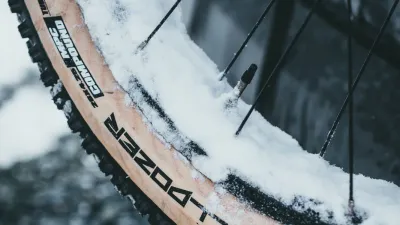
Studded bike tires have metal studs or pins embedded in parts of the tread. The studs create a mechanical contact with suitable icy surfaces. The rubber compound, tread, casing, pressure, rider input, and surface still affect control. A studded tire is not the same as a tire that merely has a winter-looking tread pattern.
Do studs help on ice?
They can help when the studs contact a hard, icy surface and the tire is used within its maker’s pressure range. Schwalbe’s winter tire FAQ explains that spiked tires are intended for winter conditions and that pressure can be changed within the stated range for different surfaces. That is manufacturer guidance for its products, not a promise of grip on every kind of ice.
The surface can change over a few feet. Wet pavement, loose snow, frozen ruts, leaves, gravel, and polished ice do not offer the same support. Keep speed and steering inputs low enough that you can stop if the tire does not behave as expected.
Are studded tires needed for ordinary snow?
Not automatically. Packed snow with no ice, loose snow, and wet pavement call for different tire and route decisions. A studded tire may be unnecessary for a route that is consistently clear and may be insufficient for deep, soft, or rutted snow. Schwalbe notes that deep snow can limit the usefulness of winter tires, so do not treat studs as a solution to every snowy surface.
Do studded tires work on wet roads?
They may be ridden on clear pavement when the tire maker permits it, but metal studs can make more noise and the riding feel can differ from a normal tire. Schwalbe advises increasing pressure on ice-free roads, while remaining inside the tire’s permitted range, to reduce noise and rolling resistance for its spiked tires. Check your own model’s instructions before changing pressure.
When are studded bike tires worth it?
Studded tires are a reasonable consideration when ice is a repeated, unavoidable part of a route and the rider can accept the cost, noise, rolling feel, and maintenance of a second seasonal tire. The decision is weaker when the route can be shifted to clear pavement, when snow is deep and soft, or when visibility and braking conditions are already outside the rider’s control.
Should you use studs on the front, rear, or both?
There is no universal front-only or both-wheel rule for every bicycle. Tire size, drivetrain, frame and fork clearance, braking, rider load, surface, and the tire maker’s recommendations all matter. A front tire that does not fit the fork or a rear tire that rubs under load is not a safe compromise.
If a manufacturer provides a matched pair or a wheel-specific recommendation, follow it. If you are considering one studded tire, ask the tire maker or a qualified shop how that choice affects the bicycle’s handling on the surfaces you actually ride. Do not infer compatibility from tread appearance alone.
Are studs useful if only part of the route is icy?
They can be useful if that section cannot be avoided and the tire is suitable for the transition to clear pavement. Slow before the surface changes, keep the bicycle as upright as practical, and avoid abrupt braking or steering. If the icy section is too irregular to evaluate, dismount rather than relying on the presence of studs.
Do studs make braking safe on ice?
No. Studs can change the tire’s available traction, but they do not guarantee a controlled stop. Braking force, surface shape, brake condition, speed, body position, and visibility still matter. The winter braking guide explains why early, gentle inputs and a sound brake system matter on wet or slippery roads.
How do you choose a studded bike tire?
Start with compatibility, then compare the tire’s intended surface and maker instructions. A tire that looks suitable in a product photo can still be the wrong diameter, width, casing, bead type, pressure range, or clearance for a particular bicycle.
What size and clearance should you check?
Match the diameter marking and approved width to the rim and bicycle. Measure or verify clearance at the fork crown, chainstays, seatstays, fenders, and brake hardware. Leave room for mud, snow, wheel flex, and the loaded bicycle as specified by the maker or frame manufacturer. If the tire rubs, do not solve it by moving a brake or removing a safety part without the correct procedure.
Schwalbe’s mounting guidance says to use the correct rim tape, fit the bead carefully, and check the bead line and pressure. Use the same care with a studded tire, whose tread and casing can make a visual clearance check less obvious.
Does tube or tubeless setup change the choice?
Yes. Confirm the tire’s approved tube or tubeless use, the rim’s compatibility, the valve and tape requirements, and any sealant or insert instructions. Do not assume a tube tire can be converted to tubeless because the casing is wide, or that every studded tire is approved for a tubeless system.
If the rim and tire limits disagree, use the more restrictive compatible system limit until the maker provides a clear answer. The winter tire pressure guide explains how to record those limits and make cautious adjustments without copying a number from another bicycle.
Does stud count determine the best tire?
Not by itself. Stud placement, tread design, casing, width, pressure range, and the route surface all influence whether a tire fits the use. Product pages may list construction details, but those details are not a universal ranking. Compare the maker’s intended use and service instructions to the actual route.
How do you install and set up studded tires?
Install the tire with the wheel, rim, tube or tubeless parts, and tools specified by the makers. Inspect the casing and bead before inflation, confirm that the bead sits evenly, and rotate the wheel to check clearance. Use a gauge and stay within both the tire and rim limits.
What is the safe mounting sequence?
- Confirm diameter, width, bead, rim, and frame or fork clearance before removing the old tire.
- Check rim tape, rim hooks or hookless requirements, valve condition, and the tube or tubeless parts.
- Fit the tire without sharp tools that can damage the tube, casing, or rim.
- Inflate gradually while checking that the bead line is even around both sides.
- Install the wheel securely, spin it, and look for tread wobble, rubbing, or a moving bead.
- Recheck pressure and retention hardware before a controlled test.
Do not ride if the bead will not seat evenly, the tire rubs, the valve leaks, or the wheel does not sit correctly. Ask a shop when the tire and rim combination is unfamiliar.
Do studded tires need a break-in period?
Follow the tire maker’s break-in instruction. Schwalbe’s current winter FAQ recommends running its spiked tires in for about 40 km on asphalt while avoiding sharp acceleration and heavy braking, so the studs can seat. That distance and procedure are specific to Schwalbe’s guidance and should not be presented as a universal rule for every tire.
During any maker-specified break-in, ride on a route with an easy exit and inspect for missing or loose studs, casing damage, bead movement, and abnormal vibration. Stop if the tire or wheel behaves differently from the manufacturer’s description.
What pressure should a studded tire use?
Use the tire and rim maker’s stated range. Schwalbe’s winter tips say its studded tires should be at the recommended minimum for the best stud grip on ice, while its FAQ describes higher pressure on ice-free roads to reduce noise. Those instructions are product-specific. Pressure should never fall below a marked minimum or exceed a marked maximum.
What are the disadvantages of studded bike tires?
The trade-offs include extra cost, a separate seasonal setup, more noise on clear pavement, a different rolling feel, stud wear, and the need to inspect the tire after rough or salty rides. None of those makes a studded tire a bad choice, but they make the route and surface decision important.
Do studs wear on pavement?
They can wear as they contact hard surfaces. Schwalbe advises using pressure and riding practices appropriate to ice-free roads and warns that spiked tires have different behavior on asphalt. Follow the model’s service instructions rather than trying to extend a worn tire by changing pressure outside its range.
Can studded tires handle deep snow?
Studs address contact with icy surfaces, not every problem caused by deep or soft snow. A tire can sink, steer poorly, pack with snow, or lose a clear line even when its studs are intact. Schwalbe’s winter FAQ notes limits in deep snow. Dismount when the bicycle cannot be guided and stopped predictably.
Do they require more cleaning?
Winter contamination can collect around any tire and wheel. After a salty ride, rinse and dry the bicycle with the winter bike cleaning tutorial. Keep the chain and drivetrain routine separate with the winter chain-care guide, and inspect the tire for embedded debris or a changing bead line.
How do you inspect studded tires?
Inspect before each ride when the route is icy or the tire has been stored. Look for a cut, bulge, crack, exposed casing, missing or loose studs, a bent or damaged rim, valve leaks, uneven bead seating, and tread debris. Check the tire and rim pressure with a gauge and confirm the wheel is retained correctly.
Replace or seek a maker’s assessment when the casing is damaged, studs are coming out, the bead will not stay seated, pressure falls unexpectedly, or the tire no longer meets its service limit. Do not file, glue, or press a stud back into a damaged casing as a substitute for the tire’s repair or replacement policy.
The snow-riding guide covers visibility, route selection, and dismount conditions. If the bicycle will be stored after the season, use the winter storage guide to keep the tires and wheel system protected.
Studded bike tire FAQ
Are studded bike tires worth it?
They can be worth considering when ice is a regular part of a route that cannot be avoided and the bicycle can accept the tire safely. They are less compelling when the route is usually clear, a different departure time removes the ice, or snow depth makes the bicycle uncontrollable. Compare the full trade-off, including noise, cost, pressure, fit, and maintenance.
Can you ride studded bike tires on dry pavement?
Follow the tire maker’s instructions. Schwalbe says its spiked tires can be used on asphalt and recommends a higher pressure on ice-free roads within the permitted range to reduce noise. Clear pavement still causes different rolling and steering sensations, so ride cautiously and inspect the studs and casing.
Do you need two studded bike tires?
There is no universal answer. The correct setup depends on the bicycle, tire maker, wheel sizes, clearance, braking, and surface. Ask the maker or a qualified shop before using a different front and rear combination, especially when the bicycle has tight fork or frame clearance.
Can you use a studded tire with fenders?
Only when the tire, fender, frame, and fork retain adequate clearance through the full wheel rotation. Snow and mud can reduce that clearance. If anything rubs or the wheel becomes difficult to turn, stop and correct the fit before riding.
Can you put a studded tire on any rim?
No. Diameter, width, bead, rim profile, pressure limits, tube or tubeless requirements, and the bicycle’s clearance all need to match. Use the tire and rim maker’s compatibility information and stop when the bead does not seat evenly.
Do studded tires prevent slipping?
No. They can help on some icy surfaces, but they do not prevent every slip and cannot compensate for speed, steering, braking, poor visibility, deep snow, or a damaged tire. Treat loss of control as a signal to stop, walk, or choose another route.
How should you store studded bike tires?
Clean and dry them before storage, keep them away from heat and chemicals, and follow the maker’s storage guidance. Inspect the studs, casing, bead, and rim before the next season. Store the bicycle using the winter storage guide when it is not being ridden.
Product selection
These tires show why stud count, size, bead, pressure range, clearance, and wheel diameter must be checked together. Bright Data verified the exact Amazon listing title, ASIN, brand, and selected listed fields on September 2, 2026. This is research-based product selection, not hands-on testing. The examples are not snow, ice, rolling-resistance, puncture, or durability tests. Confirm the exact variant and your local riding rules before purchase.
700C studded tire example
Schwalbe Winter 700Cx30C Wire Kevlar Guard Reflex Studded 50TPI 50-95PSI 805g Tire, Black, 28-inch x 1.20
A narrow studded-tire example for a bike whose measured clearances match the listing.
Bright Data verified the Schwalbe title, ASIN, 700C by 30C size, Kevlar Guard, studded construction, and listed pressure range.
Best for: A 700C or 28-inch wheel build with documented 30C clearance
- Size
- 700C x 30C, listed as 28 x 1.20
- Protection
- Kevlar Guard listed
- Pressure
- 50 to 95 PSI listed
Trade-off: Confirm rim width, frame and fork clearance, bead type, and the tire maker's pressure guidance.
Check price on Amazon26-inch studded tire example
Schwalbe Marathon Winter Plus Fahrrad Reifen // 47-559 (26×1,75´´)
A useful example for a 26-inch commuter or hybrid fit check, not a universal winter tire choice.
Bright Data verified the Schwalbe title, ASIN, 26 x 1.75 size, SmartGuard layer, and stud-pressure note.
Best for: A 26-inch wheel bike with clearance for a 26 by 1.75 tire
- Size
- 26 x 1.75 or 47-559 listed
- Protection
- SmartGuard layer listed
- Studs
- Listing says studs work best at minimum pressure
Trade-off: The wider casing needs measured clearance, and minimum pressure must follow the exact tire and wheel guidance.
Check price on AmazonBottom line
Choose studded bike tires for recurring icy conditions, not as a blanket answer for every winter ride. Verify the complete wheel and bicycle fit, use the maker’s pressure and break-in instructions, inspect the casing and studs, and stop when the route, visibility, brakes, or tire condition is outside your control.
Sources
- Schwalbe, Winter Tires and Spikes FAQ, retrieved 2026-09-01.
- Schwalbe, Winter Tips for Safe Riding, retrieved 2026-09-01.
- Schwalbe, Tire Pressure, retrieved 2026-09-01.
- Schwalbe, Tire Mounting, retrieved 2026-09-01.
- 45NRTH, Stick It to Winter: A Guide to Studded Tires, retrieved 2026-09-01.
- REI, Biking in Winter: Gearing Up, retrieved 2026-09-01.