Bike Master Link Compatibility Guide
Match a bike master link to the exact chain model, speed family, width and profile, direction, and reuse rule. Similar-looking links are not automatically compatible.
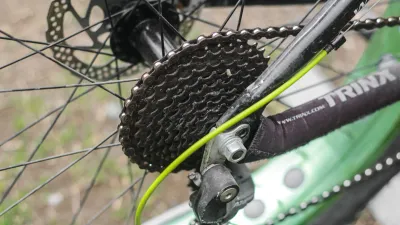
A master link must match the exact chain model or manufacturer-approved chain family. Check speed count, chain width and plate profile, drivetrain family, direction, and whether the maker allows reuse. Matching only the number of rear cogs is not enough.
Do not improvise a connecting link
An incompatible, damaged, reversed, or incompletely locked link can separate under load. Stop riding if the link has a gap, crack, bent plate, stiff movement, unusual noise, or uncertain engagement. Replace it according to the chain maker’s instructions.
The compatibility checklist
Before buying or installing a link, identify all six items:
- Chain manufacturer and exact model printed on the plates or packaging.
- Drivetrain speed/family, such as a particular 10-, 11-, or 12-speed system.
- Chain construction, including special road, MTB, e-bike, flat-top, or transmission-specific profiles.
- Approved link part number in the current chain manual.
- Direction or arrow requirement, if present.
- Reuse rule for that exact link.
If the chain model cannot be identified, do not select a link by visual resemblance. A bike shop can measure and identify it or recommend a complete compatible chain replacement.
Why speed count is not enough
Chains generally become narrower as rear-sprocket counts increase, but outside width is only one variable. Plate shaping, chamfers, pin dimensions, coatings, and engagement features can differ between product families at the same nominal speed.
SRAM’s current chain user manual directs users to the stamped chain and matching PowerLock. It also separates T-Type, Eagle, and road Flattop families rather than treating every same-speed link as interchangeable.
Do not mix brands unless both the chain maker and link maker explicitly list that exact combination. Marketplace phrases such as “fits most” are not a substitute for a compatibility table.
Are master links reusable?
There is no universal answer. SRAM states that its PowerLock is for one-time use and that a new one is required after removal. Shimano’s current QUICK-LINK instructions similarly warn against reusing a removed QUICK-LINK.
Other manufacturers may publish a different rule for a particular link. Follow the rule supplied with the exact link, and never assume that a link is reusable merely because it can be opened with pliers.
Replace any link that has seen an overload, chain jam, or crash impact, or that shows wear, corrosion, distortion, or uncertain locking. A low-cost connecting link is not worth gambling on after a questionable event.
Does orientation matter?
It can. Some links include an arrow or directional plate shape. Follow the chain and link instructions for the bike’s forward chain movement and for any top-versus-bottom orientation.
Shimano’s current 12-speed dealer manual maps specific chains to the SM-CN910-12 QUICK-LINK and shows its arrow orientation. That does not authorize the same link on an unlisted chain.
How to inspect installation
Use the maker-approved joining tool or master-link pliers and its exact procedure. After installation:
- verify both pins occupy their final locked positions;
- inspect both plates for equal seating and no gap;
- articulate the link by hand and compare its movement with neighboring links;
- rotate the drivetrain slowly and watch it pass through the cassette, chainring, and pulleys;
- confirm the link’s direction and chain routing;
- perform only the maker’s stated locking check.
Do not create a high-load pedal test in a work stand. If the link will not lock cleanly, remove it according to the manual and use a new compatible link.
Master link, connecting pin, or rivet?
Use the connection method specified for the chain. Some chains use a dedicated quick link; others may use a model-specific connecting pin or another joining system. Ordinary chain rivets should not be pushed out and reinstalled unless the manufacturer expressly permits that method.
The chain also needs the correct total length. A compatible link cannot rescue a chain that is too short, damaged, or routed incorrectly. Check the bike-chain sizing guide before shortening a replacement.
What tools do you need?
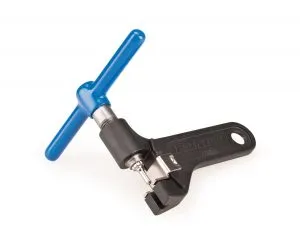
Depending on the system, you may need a compatible chain breaker for sizing, master-link pliers for opening or closing, and the exact chain manual. Tool jaws and chain cradles must support the chain’s dimensions.
Do not grip chain plates with ordinary pliers, hammer a link closed, or grind a new link to fit.
The bike chain-tool guide covers breaker and master-link tool categories, but the component manual remains the authority.
When a mechanic should take over
Use a qualified mechanic when the chain model is unreadable, the drivetrain mixes uncertain parts, the chain broke under load, a link repeatedly stiffens, the new chain skips, or chainring and cassette wear are unclear. A broken chain can also damage the derailleur, frame, wheel, and spokes.
Bottom line
Buy from the compatibility table, not from appearance. Exact chain model, family, approved part number, direction, and reuse status all have to agree. When any one of those is unknown, pause the repair and identify the system before riding.